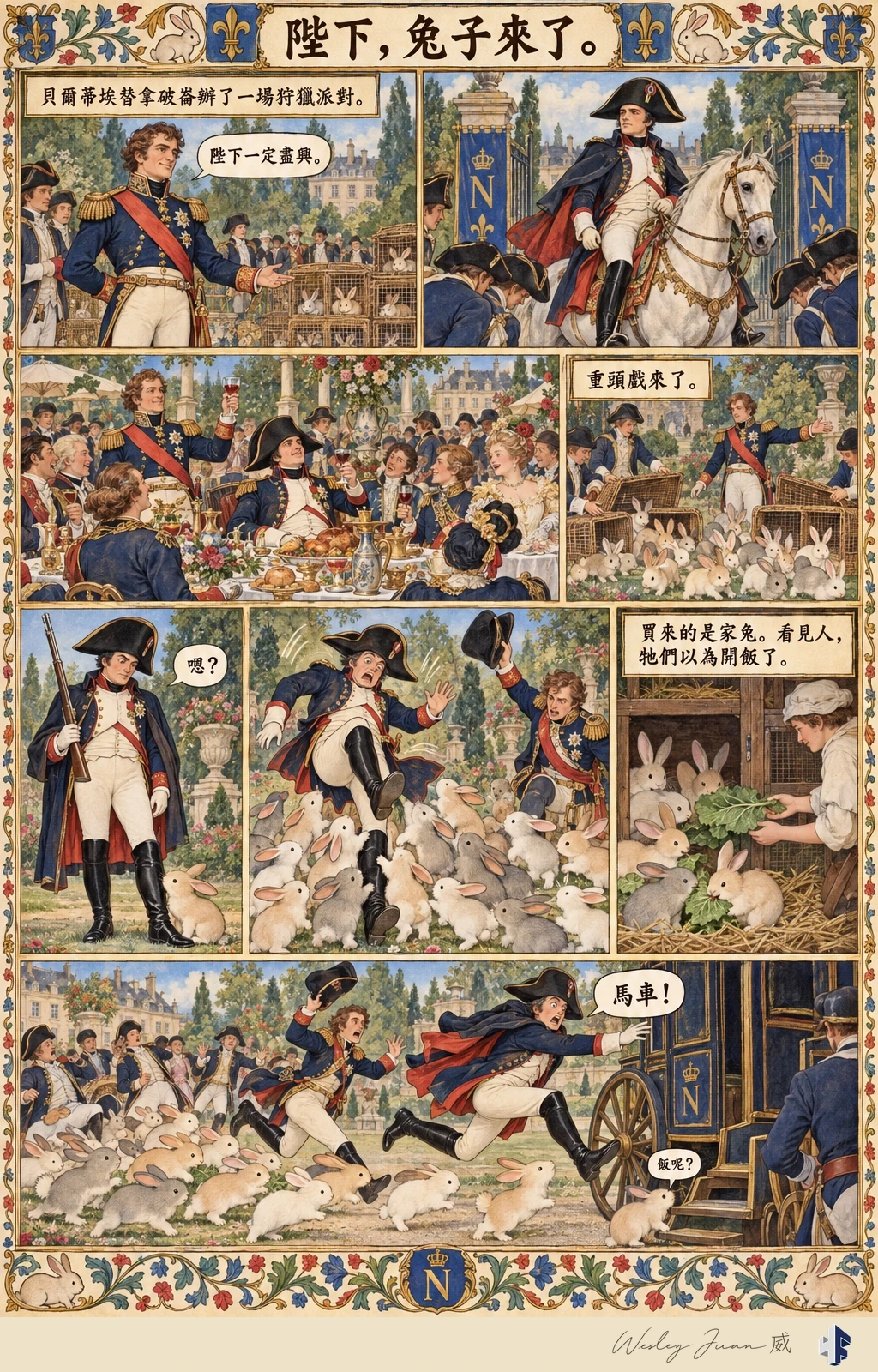
Berthier decided to invite Napoleon for a hunt. It would be on his own grounds just outside Paris: a good breakfast first, then a few rabbits for the emperor to shoot, and everyone home happy.
Every last one, Marshal.
It was a very respectable way to entertain. As far back as the Middle Ages, European nobles had treated the hunt as a pastime, some even setting aside huge tracts of land just for it. Owning your own grounds, landing the emperor as your guest and sending him home pleased: a host could hardly look better.
Besides, the man arranging it was Berthier. The marshal was Napoleon’s chief of staff, the one who turned the emperor’s ideas into orders every corps in the field could carry out. Picture a tour on a terrifying scale, the company spread across the map, the schedule changing by the hour, and everyone still expected to meet up on time. He was the man watching the whole itinerary and telling everyone where to go next. Only his tour was going to war.
This time it was just a party, and the guest was the emperor he knew better than anyone.
Napoleon accepted. Berthier went down the list item by item and soon found that his grounds had everything except the rabbits to shoot. He sent his people out to buy some: a thousand, to be let loose on the grounds the day of the hunt.
“All here?”
“Every last one, Marshal.”
He nodded. The rabbits were in place. All they needed now was the emperor.
And now, the main event.
Napoleon came down the steps, pulling his gloves snug against his palms. The people behind him made way.
Breakfast was over. He took the gun, tested its weight, and the men around him went quiet, waiting for him to lead off. Berthier had seen that ease many times on the battlefield. Today the emperor was in a fine mood, and all that lay ahead of him was a meadow.
Berthier stood to one side, waiting for the emperor to raise his gun.
The grass moved.
First one pair of ears, then two, then three. Rabbits came running out from under the trees, more and more of them. Napoleon lowered the muzzle a little and waited for them to scatter.
The first one stopped at his boot and twitched its nose.
Someone laughed.
Napoleon moved his foot. The rabbit followed. He took another step, and several more had already crowded in. Soft fur brushed his breeches; one sat up on its hind legs and rested its front paws on his leg.
The laugh stopped.
“Get them away from me.”
Berthier stepped in at once and waved the coachmen over. A long whip cracked in the air, and the rabbits parted just enough to make a gap. He stepped into it, arms spread wide, clearing a path for the emperor.
Napoleon brushed the fur off his breeches and straightened up.
Berthier turned around and was about to speak when a gray ball shot past his feet.
Then another.
The rabbits had gone around the coachmen and were pouring back in from both sides. The ones in front couldn’t stop; the ones behind kept pushing. Napoleon had barely set down his right foot when his left boot disappeared under fur. He thumped the gun butt on the grass. The rabbits hopped aside and pressed right back in.
“The carriage!”
Berthier reached out to block them, and they slipped under his hands. He grabbed a fistful of air, caught his heel on another rabbit and lurched forward.
The emperor was already several steps away.
Long strides, fast ones. Then faster.
Then he broke into a run.
The grass slid under his feet. Napoleon brought his knees up high, shaking off the rabbits tangled around his ankles, the tails of his coat slapping against his legs. The carriage was just ahead; the driver stood there, frozen. Napoleon pointed at the door and shouted twice.
Behind him, nothing but rabbits.
Berthier ran alongside, waving his hat. The attendants who had been lined up so neatly a moment ago were scattered across the lawn, some fending off rabbits, some getting out of the way, and one who finally remembered to hold the carriage door.
Napoleon grabbed the handrail and stepped onto the footboard. Something suddenly weighed on his foot: another rabbit had followed him up. He pulled his leg in, kicked, and all but fell into his seat.
“Go!”
The wheels turned. Berthier stepped back half a pace, chest heaving, hat still clenched in his hand. A rabbit stopped at his feet and looked up.
He looked down at it.
Where’s breakfast?
The buyer had bought tame rabbits.
Europeans have kept rabbits for a very long time, for the meat and for the fur. Rabbits could be raised in walled warrens or in hutches. These came from hutches. Someone usually brought them greens, so when they saw a person, they thought of food.
A hunt needs the opposite reaction: people come close, the game runs, and the guests get the fun of the chase and the aim. You want wild rabbits that hide from people. What arrived were rabbits used to waiting for people to feed them. The order went down the line, a thousand rabbits came back up, and the difference slipped right through.
Berthier had arranged the breakfast, the guns and the rabbits. How the rabbits were supposed to behave at the event, it seems, nobody had told them.
They had waited in their cages all morning on empty stomachs. At last they were let out onto the grounds, and at last they saw people.
But the people kept running.
The first one to walk over ran fastest of all.
The carriage disappeared down the park road. The rabbits chased it a little way, then slowed to a stop. Dust settled on the grass. They lifted their noses toward the spot where it had vanished.
Where’s breakfast?
Adapted from an anecdote in the memoirs of General Thiébault. The dialogue, expressions and chase are fictionalized. Other versions of the story exist.
Your notes and saves (optional)
Keep a version of your own.
Saved only in this device’s browser and never sent anywhere. Other devices won’t see it, and clearing your browsing data erases it.