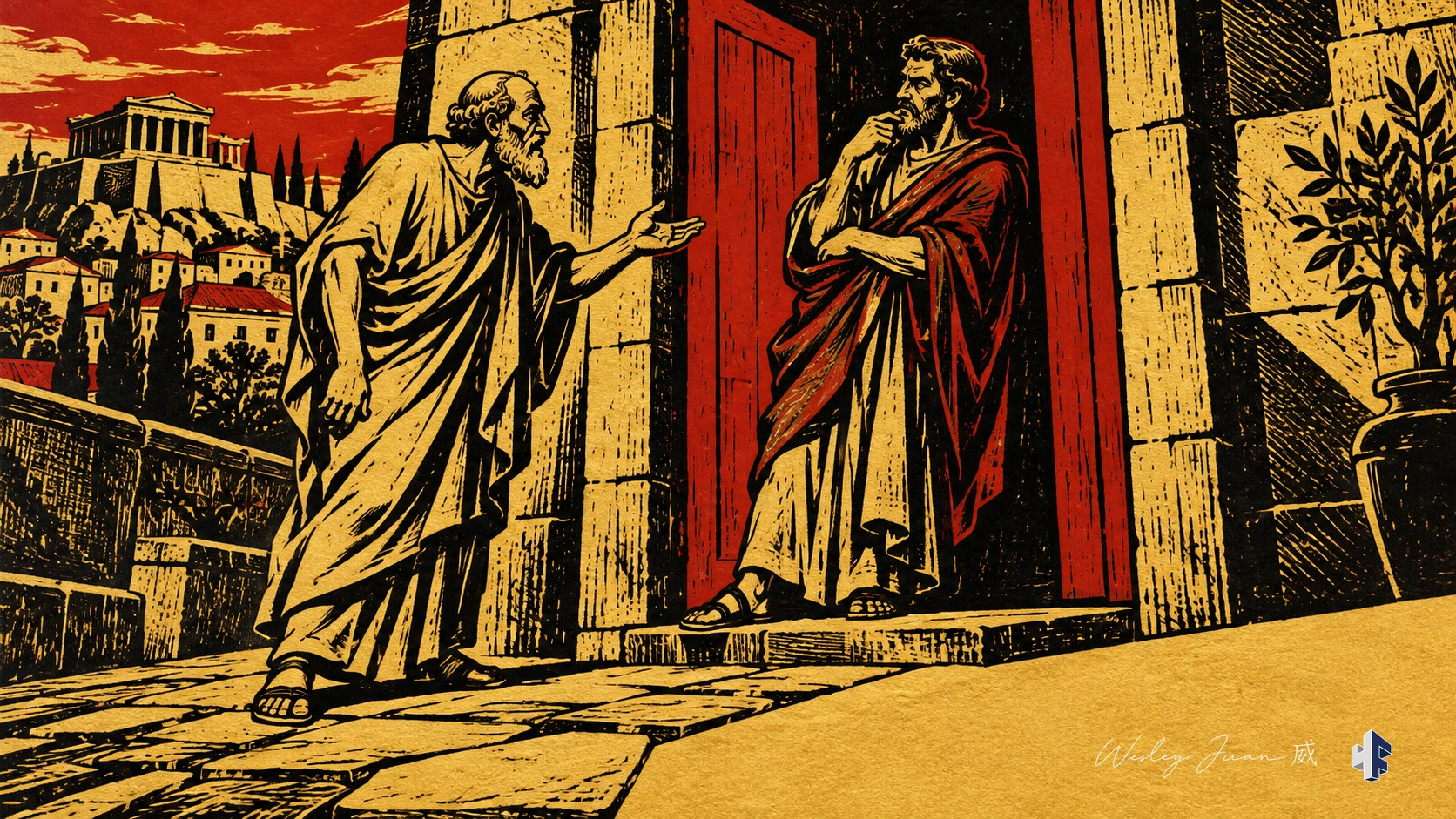
In the dialogues Plato left us, Socrates keeps running into people who are very sure of something. When the talk begins, everything seems clear. A few questions later, words that felt familiar can’t quite keep their footing.
The man who kept asking
Socrates left no writings of his own. The Socrates we read comes to us mostly through Plato, Xenophon and others; their versions don’t fully agree, so the dialogues shouldn’t be read as transcripts of what was actually said.
In the conversations Plato portrays, he presses people on courage, justice and other things they assume they understand. Someone offers a definition; then come the examples and the counterexamples. The talk often stops in puzzlement, with no conclusion you could take home and memorize.
The puzzlement is uncomfortable. It also makes visible, for the first time, the distance between “I know this word” and “I can explain it.”
Not knowing can have a definite shape
Saying you don’t know doesn’t mean canceling every judgment at once. You know a certain act struck you as brave, yet you still can’t say what separates courage from recklessness. What’s missing is a boundary. The experience is all there.
We can borrow his way of asking for a small thought exercise today. Someone says courage means not being afraid. So what about a person who is terrified and still says what needs to be said? Is that courage? If it is, the definition needs revising.
A counterexample doesn’t make the other person lose the whole conversation. It takes away one condition that wasn’t precise enough and leaves the rest still to be sorted out.
Make your “I don’t know” more specific, and the next question can find its way in.
Is equal the same as fair?
Two people get exactly the same amount of time, but one of them needs help to finish what they’re saying. Some call that fair. Others feel the time each of them really had to speak was never the same.
Switch to sharing by need, and who decides how much each person needs? The tidy definition you started with can’t quite sit still.
Maybe you still back equal shares and just want to add a condition. Or maybe you find that what you cared about most was never the amount.
The way you ask gets questioned too
Today’s sparring session doesn’t copy the scenes in the old texts where people are put on the spot. If questions are used only to prove “I knew all along you didn’t get it,” the two of you are just rearranging who sits higher.
“Can we stay on this point a little longer?” Give the other person the chance to ask you that, too. When they point out that your counterexample actually changed the conditions, don’t rush to the next question. Deal with their point first.
What we take from Socrates isn’t that asking “why” a few more times will beat everyone else. It’s practice at setting a certainty down where it can be examined together. When the questions stop, everyone should still have a place to sit.
How do you tell whether someone is brave or just reckless? When both lead to the same action, what shapes your judgment?
Your notes and saves (optional)
Keep a version of your own.
Saved only in this device’s browser and never sent anywhere. Other devices won’t see it, and clearing your browsing data erases it.
Further reading and sources
- Stanford Encyclopedia of Philosophy|Socrates ↗
On the sources for Socrates and the problems of interpreting them. The fairness and courage exercises are my additions.