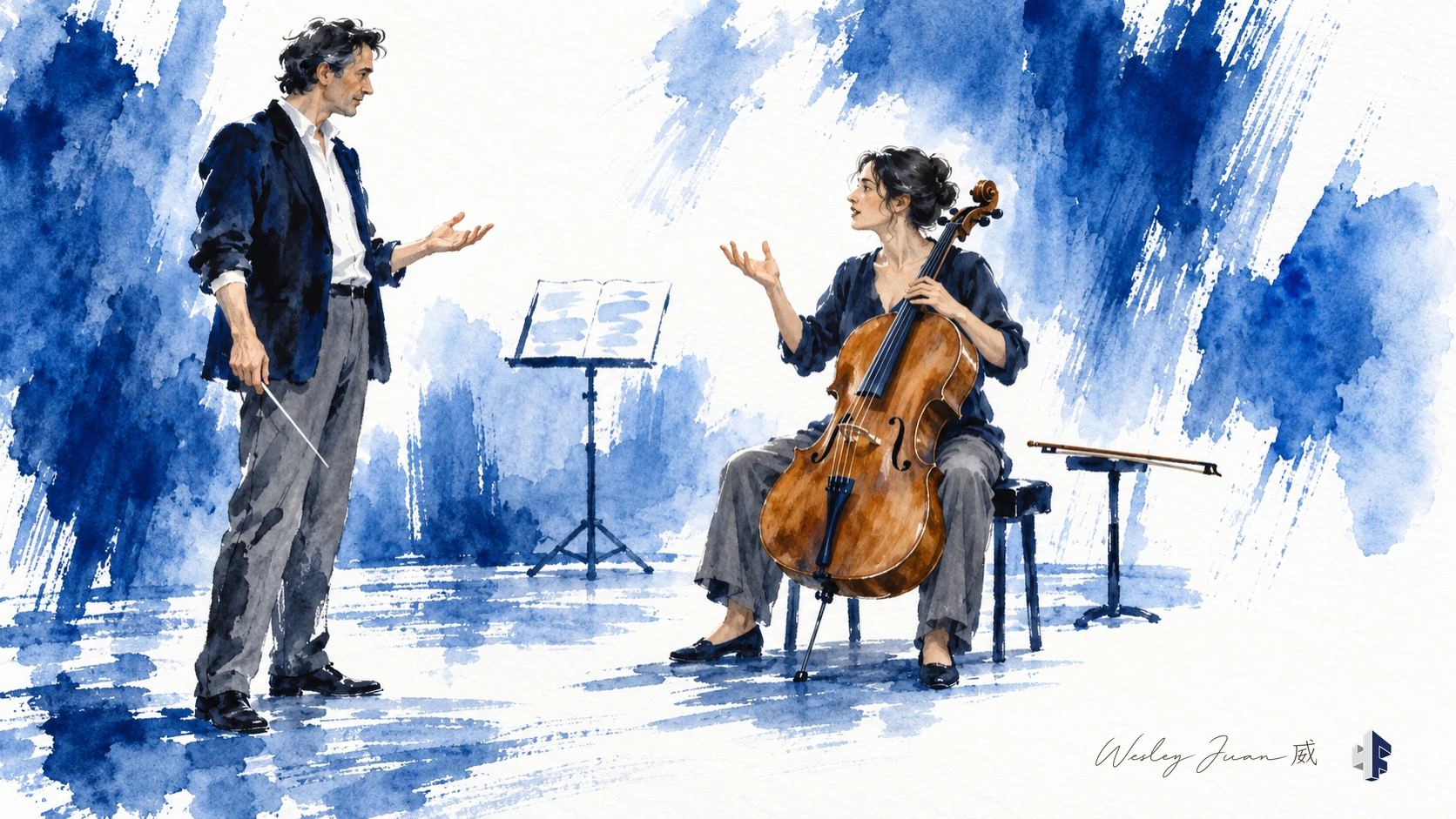
Someone says a good team is like an orchestra. You see it at once: the conductor, the players, each section, and the performance when it all comes together. It’s a clear picture. And so the next line slides right in: “So everyone just needs to do what the conductor says.”
A picture shows you one part and hides another
The convenience of a metaphor is that it saves you explaining from scratch. Say a team is like an orchestra, and we can talk straight away about roles, rhythm and listening to each other. Abstract collaboration suddenly has a sound you can imagine.
But say this is a new project still looking for its direction. There’s no shared score yet; nobody has even decided what’s on the program. Carry “follow the conductor” along with the picture, and a question about who gets to decide has been answered before anyone discussed it.
You can keep the first half of the picture and set its conclusion aside for now. The team does need to play together. Who sets the direction, and how the plan gets changed, still has to come back to the actual work.
Say which likeness you’re borrowing
When you use a metaphor, you can add one line: “This is the part I mean.” A team is like an orchestra in that however brilliant one player is, they still have to listen for everyone else’s timing. You’re not also claiming every piece of work should be run by one person giving orders.
That small qualifier keeps the discussion going. The other person can answer: “If you mean hearing each other, I agree. If you mean fixed parts, the work we’re doing right now needs people to rotate.”
The picture is still there. You’ve just started to notice that the thing you’re still arguing about isn’t in it. You can borrow one passage and leave the rest of the world where it stands.
A metaphor can lend you a beam of light. Which way to go is still yours to decide.
Switch metaphors and see what the first one left in the dark
The same team could also be like people cooking together. Someone watches the heat, someone washes vegetables, and when it gets busy, people cover for each other. The menu changes as you go, and at the end everyone cleans up together. This picture draws your eye to a different kind of teamwork.
It breaks down too. Some work has strict specialist roles; you can’t swap people around just because everyone wants to help. And the closeness of a shared kitchen doesn’t mean responsibility at work can run on unspoken understanding alone.
Two metaphors side by side won’t give you a version that’s right forever. What they show is that the arrangement you just took for granted only looked obvious because the first picture was louder. Reality never insisted on it.
Take the metaphor away and see if the reasons are still standing
When the discussion heads toward a decision, set the pictures down for a moment and lay out the arrangement plainly. Who holds which information? Which calls need whose input? If things change, how does everyone find out, and how does it get fixed?
If the reasons still hold once you take away “orchestra,” the metaphor did its job of helping you understand. If all that’s left is “because that’s how orchestras work,” there’s a stretch between reality and the picture that still needs filling in.
A good metaphor gets you to the problem faster, and lets you walk away from it when you need to. You don’t have to give up the lovely lines. Just remember they’re company along the way. Where to stop, and which way to go, still depends on the road in front of you.
Compare a team to an orchestra. Which experiences of working together suddenly make sense, and which differences get drowned out by “everyone follows the conductor”?
Your notes and saves (optional)
Keep a version of your own.
Saved only in this device’s browser and never sent anywhere. Other devices won’t see it, and clearing your browsing data erases it.