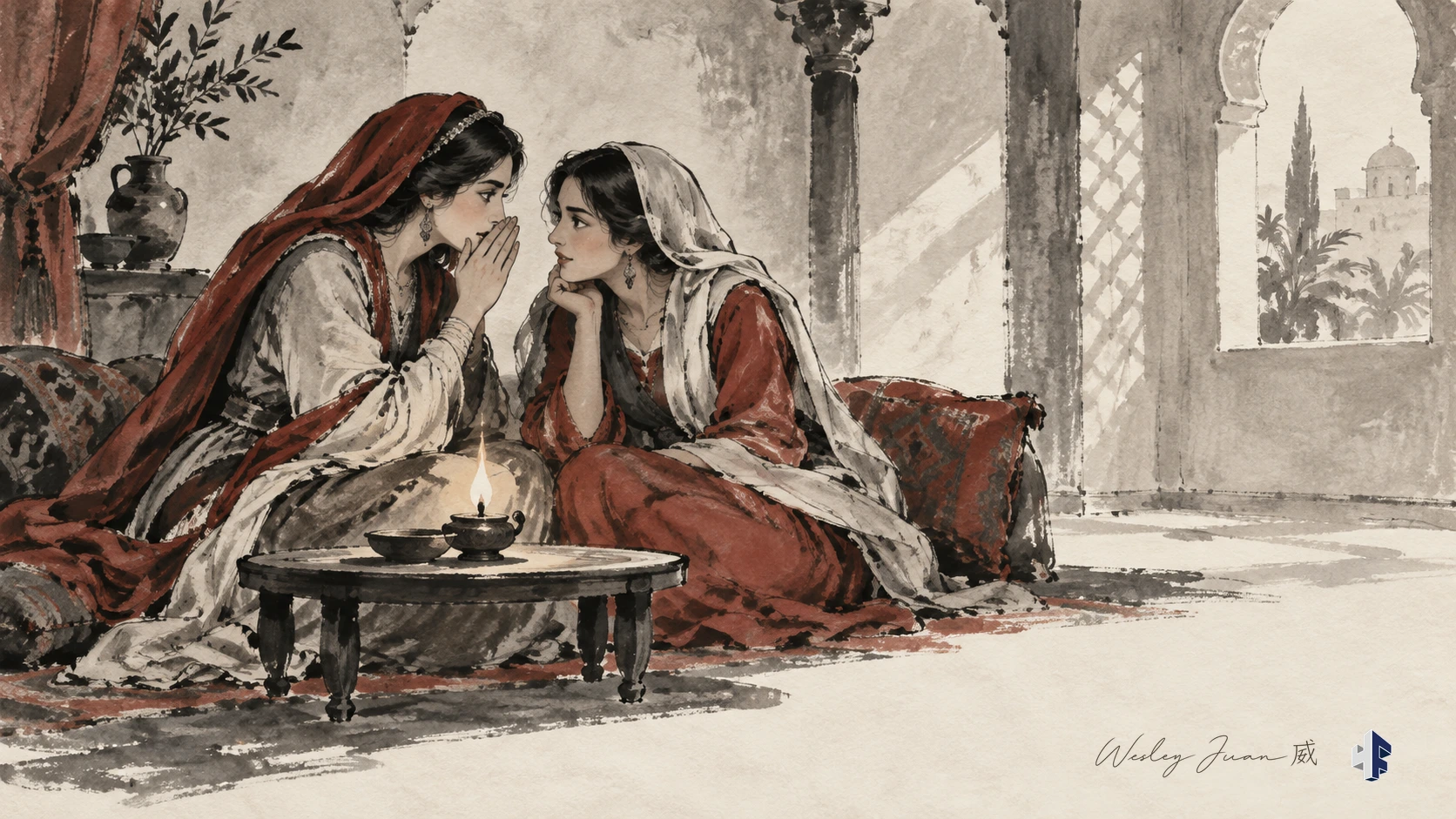
That night, the younger sister spoke up, just as they had agreed.
Sister, tell me a story.
Scheherazade looked at the king first. Only with his permission could she begin.
One more listener in the room
The king’s name was Shahryar. His wife’s betrayal had led him to take a new bride every day and kill her the next morning. In the city, some families had lost daughters; others had fled with theirs.
The vizier charged with arranging the marriages had now sent his own daughter to the palace.
Scheherazade had come of her own free will. She was well read, knew the deeds of those who came before, and remembered a great many stories. Her father could not talk her out of it. Before she went to the palace, she made a pact with her younger sister: sometime in the night, find a moment and ask for a story.
The sister asked. The king agreed.
She began with a man who had set out on business.
A matter of a few dates
Hot from the road, the merchant sat down under a tree and took out his provisions and some dates. He ate the fruit and tossed the pits away without a thought.
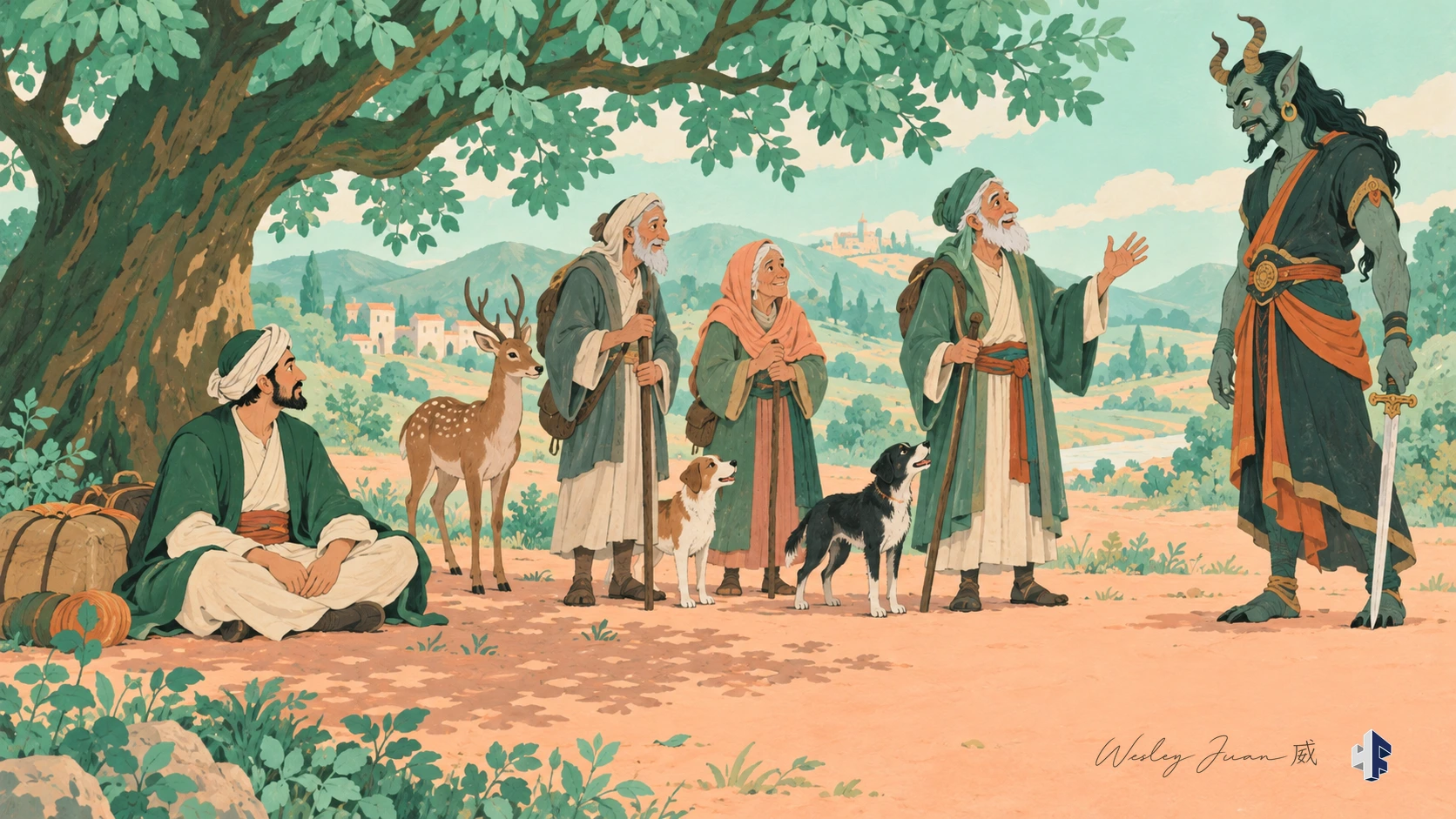
Suddenly a jinni appeared in front of him, sword in hand.
Get up. You killed my son, and I will kill you.
The merchant had no idea what he was talking about.
The jinni said his son had been passing by, and a date pit the merchant tossed had struck him in the chest and killed him.
The merchant begged for mercy. He hadn’t meant it; he had never even seen the boy. The jinni would not let him go.
The sword was already raised. The merchant spoke again, and this time what he begged for was time.
He had a wife and children, accounts to settle, goods other people had left in his keeping to return. Let him go home and put his affairs in order. In a year, he would come back to this spot.
The jinni made him swear.
He swore, and was allowed to leave.
On that trip home, everything had a deadline. The accounts were settled, the goods in his keeping handed back, and his family told what had happened. He spent the year with them.
When the day came, the merchant packed his own shroud, said goodbye to his weeping family and set out again.
He really did come back.
First, hear my story
The merchant sat at the appointed spot and wept. An old man leading a gazelle came by and asked why he was sitting alone in a place like this.
He told him the whole thing. When he had heard it, the old man decided to stay and see how this appointment would end.
Then a second old man came along with two black dogs. After him, a third old man arrived leading a mule. All three sat down to keep him company.
Dust rose. The jinni had arrived.
He seized the merchant, ready to carry out the agreement of a year before.
The old man with the gazelle stepped forward and proposed a different deal: let him tell the story of himself and this gazelle. If the jinni found it strange enough, would he waive a third of the merchant’s death sentence?
The jinni agreed.
The old man said the gazelle had once been his wife. She knew magic, and she had turned his son into a calf. Not knowing, he had nearly killed his own child with his own hands.
The story had reached the old man walking toward the calf with a knife when dawn broke.
In the palace, Scheherazade stopped.
Her sister marveled at the story. Scheherazade said that if she lived until tomorrow night, there was better to come.
The king wanted to hear the rest.
That morning, she lived.
Three stories, one life
The next night, Scheherazade went on.
The old man did not kill the calf in the end. Later, the herdsman’s daughter saw through the spell, turned the son back into a man, and turned the wife who had cast it into a gazelle. Now the old man had led her here.
When the jinni had heard it, he waived a third of the merchant’s death sentence.
The second old man stepped up. The two black dogs at his side had once been his brothers. He told what had passed between them and won the second third.
The third old man told the story of himself and his mule. The jinni was amazed, and at last agreed to waive the rest.
The merchant didn’t have to die.
He embraced the three old men and thanked them. A few strangers had met in a place where a man had come to wait for death, and in the end each set off for his own city.
He had come carrying a shroud. He went home still not needing it.
Back to that room
The merchant’s story was over. The storyteller was still at the king’s side.
Scheherazade went on to mention something else: what happened to a certain fisherman was stranger still.
The king asked: and how was that?
The younger sister was still in the room. The older one began again.
Wesley murmur
Hold on. You eat a date, toss the pit, and it kills a jinni’s kid? I’m not trying to argue physics with a fairy tale, but isn’t there a step missing? Even if it said he bumped into something by accident and only later found out it was the jinni’s child, I could follow along better.
Stories inside stories, and the people inside those start telling stories too. Christopher Nolan would tip his hat.
Those three old men could all have kept on their way. What made them sit down?
Retold from the frame story of One Thousand and One Nights and “The Merchant and the Jinni,” with the three old men’s tales abridged.
Your notes and saves (optional)
Keep a version of your own.
Saved only in this device’s browser and never sent anywhere. Other devices won’t see it, and clearing your browsing data erases it.
Further reading and sources
- Richard F. Burton’s translation of One Thousand and One Nights, vol. 1: the frame story, the merchant and the jinni, and the three old men ↗
In this edition, the first night breaks off during the first old man’s tale of the calf; the merchant is set free on a later night.
- Husain Haddawy’s translation, postscript: the traditional ending for Scheherazade and the king ↗
The translator’s postscript mentions one traditional ending in which the king finally comes to trust and love her and keeps her as his queen.