That morning, the vizier came to the palace carrying his daughter’s shroud.
He knew what the king did every morning. He was the one who had carried out those orders.
Last night, the bride he delivered had been his own daughter.
But the king went about the business of state, promoting one man, dismissing another, and never told him to kill her.
The vizier waited.
To explain why he was standing there, we have to go back to a visit between two brothers.
It happened to the younger brother first
Shahryar was a king, and so was his younger brother, Shahzaman; each ruled a land of his own. They hadn’t seen each other in years. The older brother missed him and sent envoys with gifts to invite him.
The younger brother packed, and his caravan made camp outside the city, ready to leave the next day. In the middle of the night he remembered something he’d forgotten and quietly slipped back into the palace.
His wife was in bed with another man.
He killed them both, returned to his caravan and set off to see his brother. The whole way, that room came with him.
The older brother welcomed him happily and got a brother with a sallow face who didn’t want to do anything. Asked what was wrong, he blamed the long trip. Doctors were called; they did no good.
Later, the older brother went hunting. The younger stayed behind in the palace, sat by a window, and watched his brother’s wife lead a party into the garden and meet a lover there, too.
Strangely, his spirits lifted a little.
When the older brother came back, he saw that his brother looked better. He pressed him, and finally heard the two things he had been hiding.
Shahryar wouldn’t take it secondhand. The brothers pretended to ride out hunting, crept back in the night, and the next day hid by the window.
This time he saw it with his own eyes.
Two kings up a tree
Shahryar couldn’t bear it and decided to leave. He and his brother would go out into the world and see whether anyone in it had worse luck than they did.
They came to the sea and rested under a tree. Suddenly a black column rose out of the water, taller and taller, heading for the shore.
The two kings climbed the tree.
It was a giant jinni carrying a chest. He sat down under the tree, opened lock after lock, box inside box, and let out a woman. He had carried her off on her wedding night.
The jinni laid his head in her lap and fell asleep.
The woman looked up, saw the brothers in the tree, and beckoned them down. They didn’t dare. So she threatened to wake the jinni and have him kill them both, forcing them to come down and sleep with her.
Afterward she took out a string of rings and said each one had been left by another man. The brothers each had to hand over one as well.
The jinni locked her in a chest and sank it to the bottom of the sea, and still couldn’t control her.
As they left, the brothers concluded that if even a jinni this powerful couldn’t keep watch over a woman, what had happened to them was nothing remarkable.
The conclusion Shahryar brought back to the palace: no woman can be trusted.
The women of the city, who had never laid eyes on him, didn’t know their fate had already been settled.
The father who found the brides, and killed them
Back at the palace, Shahryar had his wife put to death, and killed others in the palace as well. He made a new rule: every night, a new bride; every morning after, an execution.
He wanted to be sure he would never be betrayed again. A bride who lives only one night has no afterward.
The vizier was ordered to find the brides, and ordered to carry out the executions. According to the text, this went on for three years. People in the city wept, people cursed the king, and parents fled with their daughters.
Until one day the vizier couldn’t find anyone.
He went home afraid he would lose his own life. His elder daughter asked him what was wrong.
Her name was Scheherazade. She had read histories and poetry and the stories of those who came before, and she remembered what those kings had done, and what happened afterward.
When her father had finished, she said: let me marry him.
Her father was nearly beside himself. He knew all too well what would happen the next day.
Scheherazade knew too. She meant to try to save those women and make this stop, even if it cost her her life.
Her father scolded her, pleaded with her, even told her stories to change her mind.
This time, the stories didn’t talk the listener out of anything.
She held firm. At last her father went to the palace and told the king what his daughter wanted. The king made a point of reminding him: tomorrow morning, the rule still applies.
The sister knew when to speak
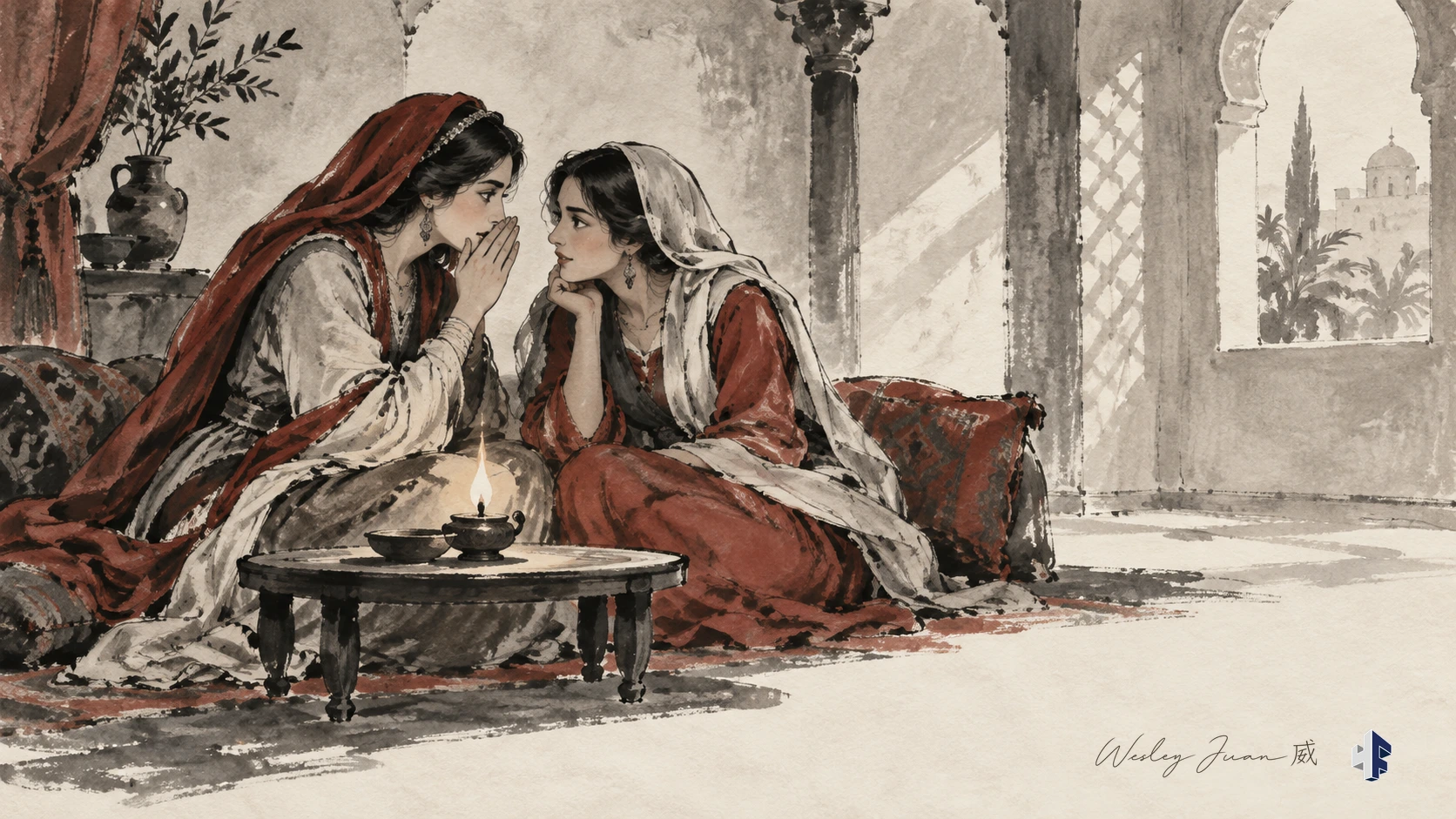
Before going to the palace, Scheherazade called her younger sister, Dunyazad, and told her what to do that night.
When I send for you, find a moment and ask me for a story.
Once she was with the king, she wept. The king asked what was wrong. She said she had a younger sister and wanted to see her one last time before dawn.
The king sent for the sister and let her stay near the bed.
In the night, the sister spoke up as they had agreed: Sister, if you’re not asleep yet, tell us a story to help pass the time.
Scheherazade said she would, if the king allowed it.
The king was still awake too, and he agreed.
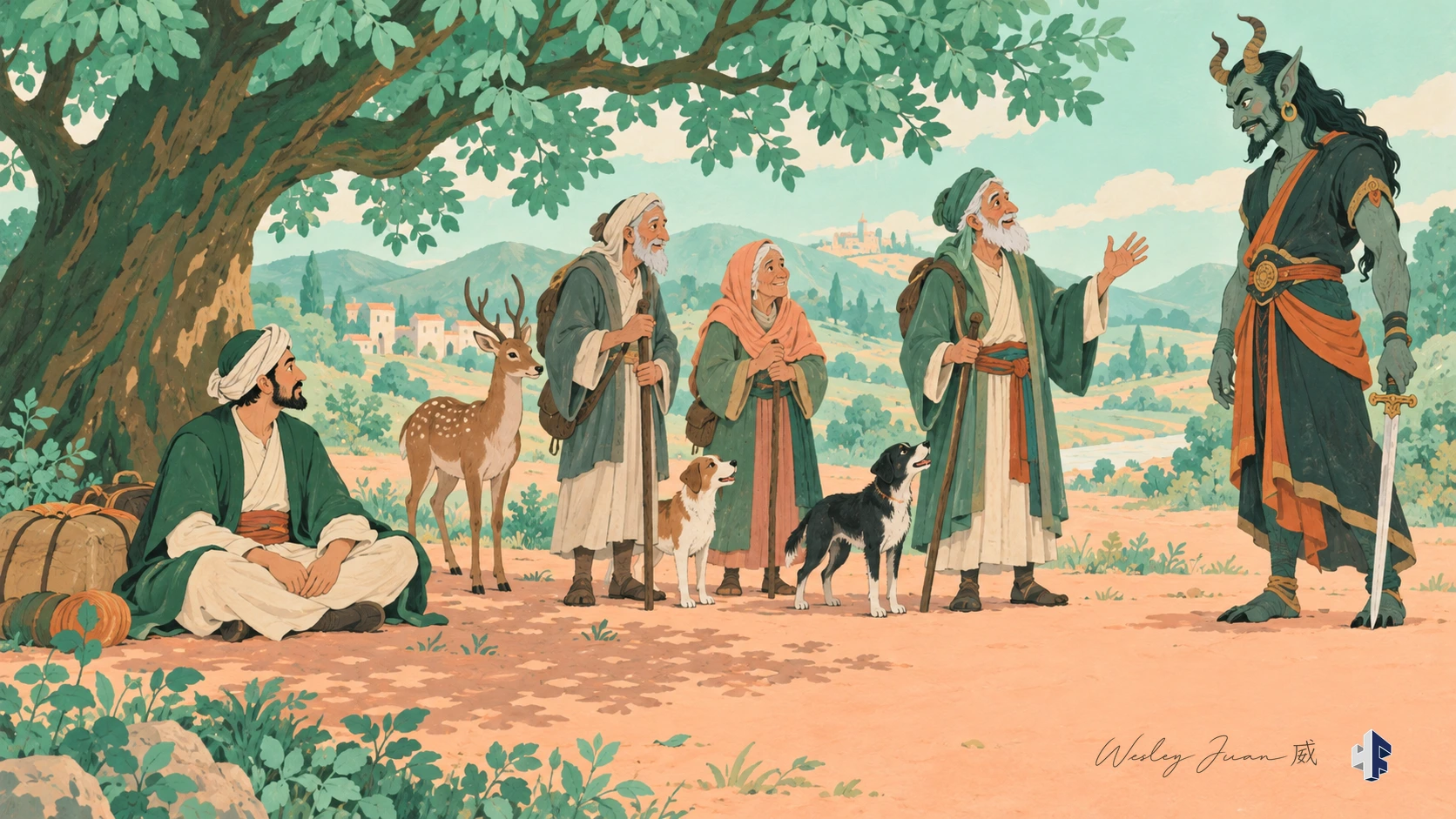
She began with a merchant. Away on business, he ate some dates under a tree, and a pit he tossed without thinking brought a jinni down on him, sword in hand.
The merchant’s death was put off for a year. Then three old men arrived, and one of them started telling about his own family.
One man was waiting to die, and another man’s story carried off everyone listening in the room.
Let her live till tonight
In Burton’s version, the first night stops in front of a calf.
The old man, not knowing the calf was his own bewitched son, walks toward it with a knife.
Dawn came. Scheherazade stopped.
Her sister said what a wonderful story it was. Scheherazade replied that if she lived until tomorrow night, there was better to come.
The king decided privately that he would hear the end before he killed her.
So that morning, the vizier came to the palace with the shroud, and the familiar order never came. The king was busy all day and offered him no explanation.
That night, Scheherazade was still there. Her sister asked her to go on, and the king allowed it.
The calf’s story got its ending. The merchant’s trouble was finally resolved. But then Scheherazade brought up a fisherman, the king wanted to hear it, and so she kept going.
After that came traveling merchants, kings, poor men, swindlers, clever people and people too clever for their own good. Sometimes a man was just about to get free when another affair caught hold of him; sometimes a character in a story opened his mouth and brought out a tale from even further back.
At dawn, she stopped. When night came again, she began.
And so the woman who had been allowed only one night stayed on in the palace, night after night.
On to the thousand and first night
Not every version ends the same way. In the ending Burton includes, so much time has passed that Scheherazade has had three children.
When the story of the thousand and first night was done, she stood and asked the king for one thing.
She had the children brought in. One could already walk, one was still crawling, and one was still nursing.
She set them before the king and begged him to spare her life: if he killed her, these children would have no mother.
The king wept and took the children in his arms. He said he had decided to pardon her before the children ever came.
He said it as if it were something settled long ago.
Yet even at that moment, she still had to bring in the children and ask him herself.
Scheherazade went on to remind him that kings before him had suffered greater misfortunes than his. She had told him so many stories; by now, he ought to understand.
In this ending, the king finally blamed himself for the killings. The next day he called his court together, told them he had changed his mind, thanked the vizier for giving him his daughter, and laid on a wedding and a feast for the people of the city to eat and drink.
Scheherazade stayed and became his queen. Her sister was married too; Scheherazade’s condition was that the two sisters never be separated.
The palace began making plans for the days ahead.
This time, Scheherazade got to finish the story.
The king says he had decided long ago not to kill her. For Scheherazade, at what point was she ever really safe?
Retold from the frame story of One Thousand and One Nights, following the opening and ending of Burton’s version, with the dialogue simplified.
Your notes and saves (optional)
Keep a version of your own.
Saved only in this device’s browser and never sent anywhere. Other devices won’t see it, and clearing your browsing data erases it.
Further reading and sources
- Burton’s translation of One Thousand and One Nights, vol. 1: Shahryar and his brother, Scheherazade at the palace, and the first night ↗
The opening covers what happened to the brothers, the jinni by the sea and the woman in the chest, the vizier and his daughter, and the sister who helps with the storytelling. The first night breaks off in the middle of the first old man’s tale of the calf.
- Burton’s translation of One Thousand and One Nights, vol. 10: Conclusion ↗
The ending spells out the three children, Scheherazade’s plea for her life, the king saying he had already pardoned her and repenting, and the sisters’ later marriages.
- Husain Haddawy’s translation: Translator’s Postscript ↗
In a brief postscript, the translator mentions the traditional ending in which the king learns to trust and love Scheherazade and keeps her as his queen. This comes from the postscript; it is not an ending the main text of that edition plays out.