In 1948, an engineer at Bell Labs published a paper with a plain-sounding title, “A Mathematical Theory of Communication.” Its author was Claude Shannon. The paper came to be seen as the founding text of information theory, and Shannon himself got called the father of the information age.
The problem Shannon set out to solve was a practical one. When a signal travels down a telephone line, how do you make sure that what arrives is the same sentence that was sent, with no noise scrambling it on the way? But his answer reached far past the telephone line. He took “information,” an everyday word, and turned it into a number you can calculate exactly.
His definition goes like this: how much information a sentence carries depends on how surprising it is. Tell someone the sun will rise in the east tomorrow and you’ve given them no information at all. They already knew, and saying it was the same as saying nothing. Tell them it will snow tomorrow in Pingtung, down in subtropical southern Taiwan, and the information content is huge, because it breaks what they expected and forces them to adjust their picture of the world. Two sentences of the same length can differ in information by a factor of a thousand, so it has nothing to do with how much is said, and everything to do with how much of what you took for granted the sentence breaks.
Shannon put a number on this degree of expectation-breaking. He called it entropy, and its unit is the bit. A fully predictable sentence has entropy close to zero; a completely unexpected one has high entropy. It sounds abstract, but it explains something everyone has experienced: why some conversations leave you feeling you’ve learned something, while others run for an hour and you take nothing away. What you take away is always the part that surprised you. The rest is what you already knew, told to you again.
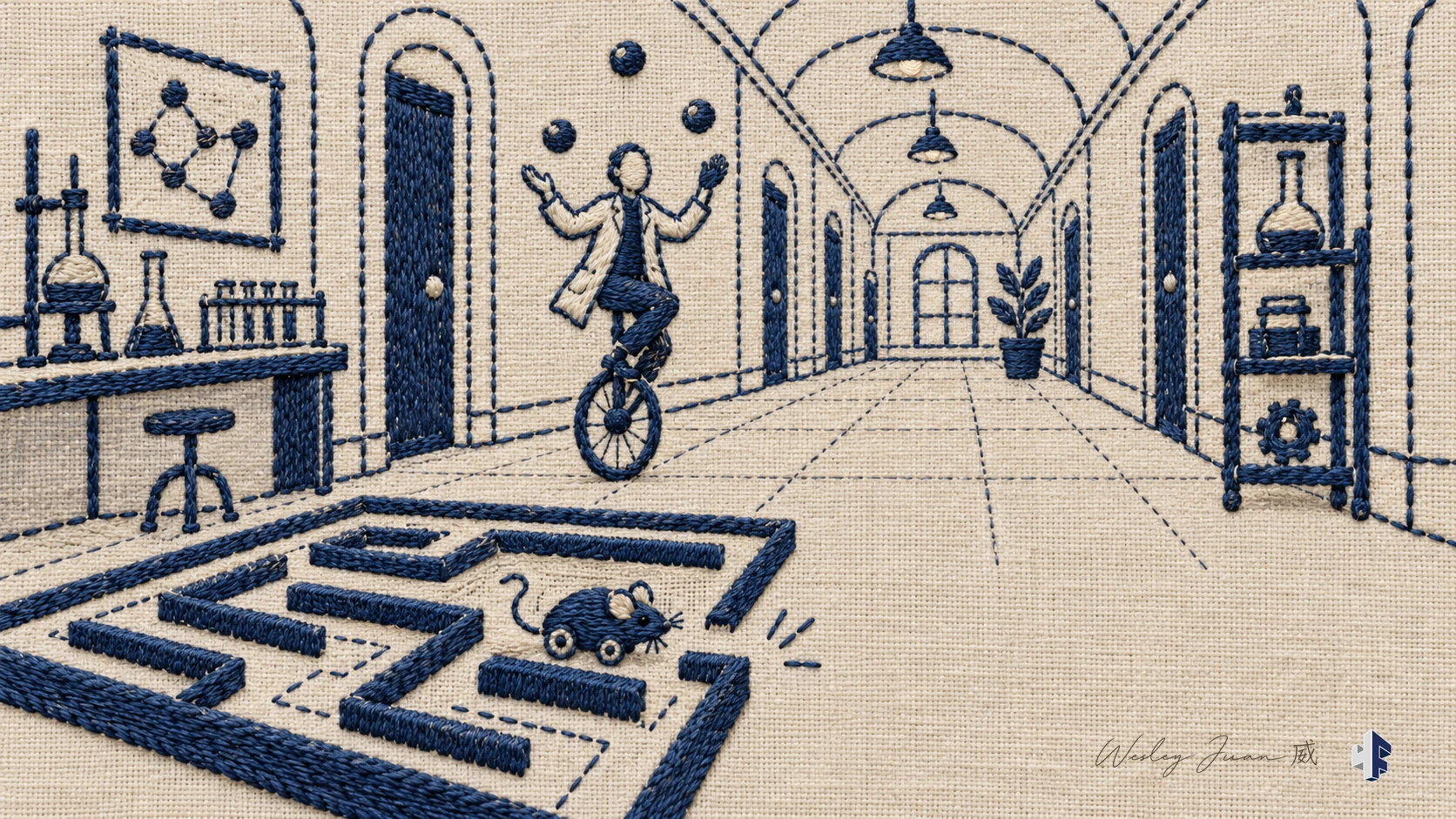
Shannon himself was a delightful character. By day he worked out rigorous mathematical proofs in the lab; privately he was a playful eccentric who, so the story goes, liked to ride a unicycle down the corridors while juggling. He also built a mechanical mouse named Theseus that could find its own way out of a maze, which in the 1950s was one of the earliest public demonstrations that a machine could learn. The exacting mathematical mind and the childlike love of play never seemed to clash in him. They looked like two ways the same curiosity showed itself.
Information theory went on to seep into nearly every technology that has to do with communication, from mobile signals to internet compression, all of it standing on Shannon’s shoulders. But what’s most useful to the ordinary reader is the test he left behind: whether a sentence is worth anything depends on whether it tells you something you didn’t already know.
Next time someone says something that gives you no sense of surprise at all, stop and ask what that sentence actually brought you, or whether it just put what you already knew in different clothes.
By the way, if you’ve only just heard of Shannon today, and those few paragraphs made you blink, then you just experienced a bit of information firsthand. No need for me to say more. You’re already ahead.
Your notes and saves (optional)
Keep a version of your own.
Saved only in this device’s browser and never sent anywhere. Other devices won’t see it, and clearing your browsing data erases it.