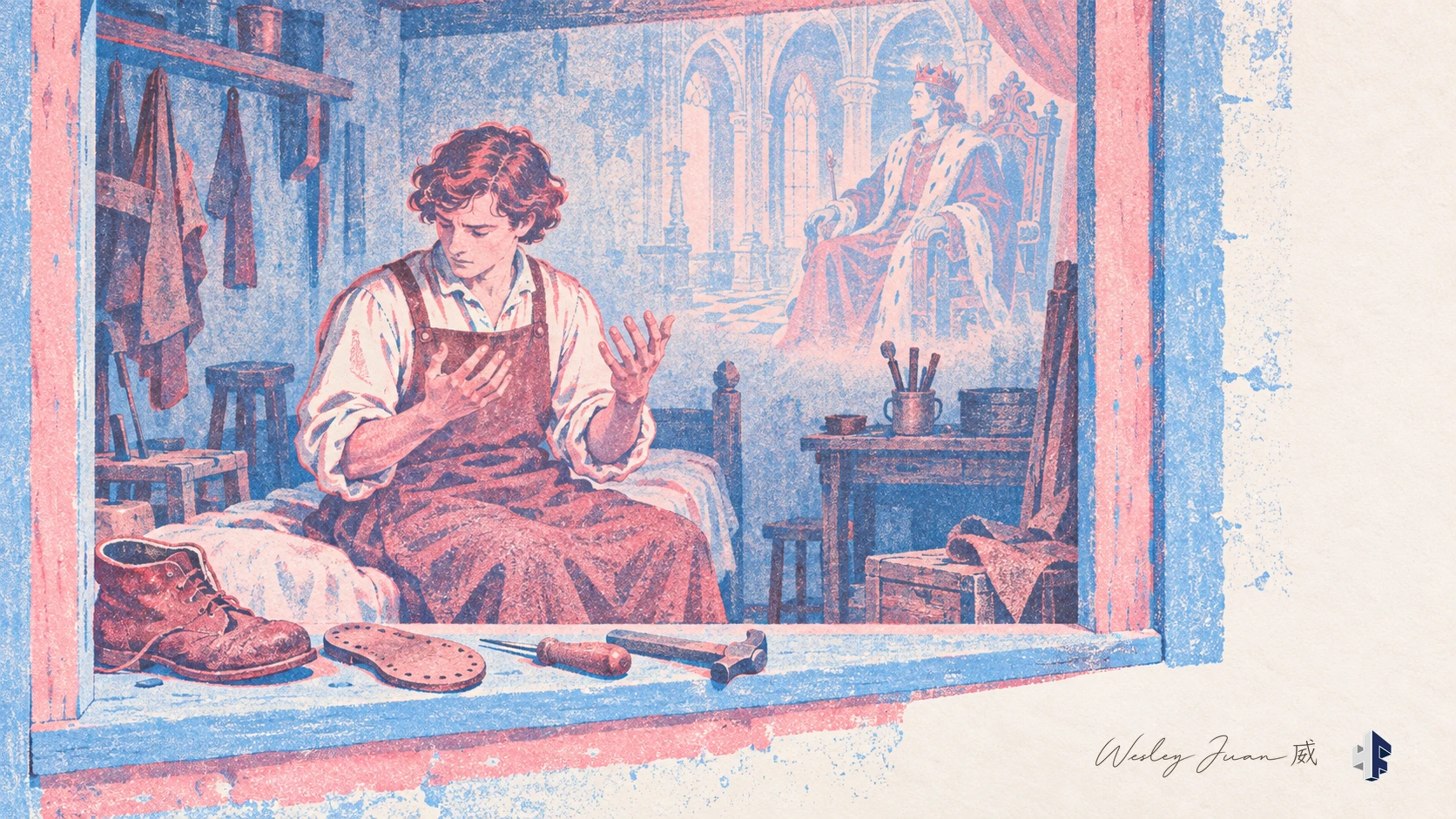
Locke asks his readers to imagine this: the consciousness of a prince, carrying his old thoughts, enters the body of a cobbler. The man who wakes up has the cobbler’s face but knows himself through the prince’s life. Right now, what would you call him?
One body pulls several kinds of “same” apart
This is a thought experiment from An Essay Concerning Human Understanding. Locke uses it to separate the man, a living creature, from the person, who can own actions and thoughts as their own.
He puts continuity of consciousness at the center of personal identity. But boiling his argument down to “you are only what you remember” skips a lot of difficulty; how to understand consciousness and memory has itself been argued over for a long time.
The first thing the story shows us is that an everyday phrase like “still the same person” is talking about appearance, continuity of life, self-understanding and responsibility all at once. We thought there was one question. There were several, stacked on top of each other.
Same name, very different life
Step out of the thought experiment and look at a closer scene: someone changes jobs, leaves the city he knew, and stops caring about the things he used to love. An old friend says he isn’t himself anymore.
This everyday example is mine. What the friend cares about is that the way they spend time together has changed; what he cares about is finally living by what he needs now. Both of them say “himself,” and they don’t mean the same thing.
If those meanings aren’t spelled out, the conversation easily shrinks to who is being more sincere. You can ask directly: when you say I’ve changed, which habit, promise or relationship do you mean? Which part needs explaining, and which is just a new preference?
Change doesn’t erase the past, but it does ask you to say which parts are being rearranged.
New business card. Who’s still waiting on you?
He no longer introduces himself with that job title, yet friends still bring him the same old work. Some forgot. Some don’t believe he really wants out.
If there are things he promised to finish, they need to talk about how to wrap them up. But after that? Will the thing he used to be good at keep deciding his next invitation?
This is a life question that branches off the story. He says “I’m not who I used to be,” and his friend hears a goodbye. Or maybe, for the first time, just hears how he’s really doing.
A thought experiment lights up a question, and leaves corners dark
The prince-and-cobbler setup strips away a lot of real-world detail for a moment so we can see one particular distinction. But faced with memory loss, illness or caregiving, this story alone can’t settle an ethical or legal judgment.
In life there are also people who remember your voice, some small habit of yours, the years you spent together. Where do those continuities belong?
We bring Locke into the sparring session so that a familiar word can unfold layer by layer. When you say you’ve changed, you can say more clearly where the change happened; when you want to be understood, you have a better sense of what still connects you to other people.
An old friend says you’re not yourself anymore. Which changes are you glad of, and which commitments do you still want to take seriously?
Your notes and saves (optional)
Keep a version of your own.
Saved only in this device’s browser and never sent anywhere. Other devices won’t see it, and clearing your browsing data erases it.
Further reading and sources
- Stanford Encyclopedia of Philosophy|Locke on Personal Identity ↗
Different readings of the prince and the cobbler, consciousness and personal identity. The exercises on work and commitments are my additions.