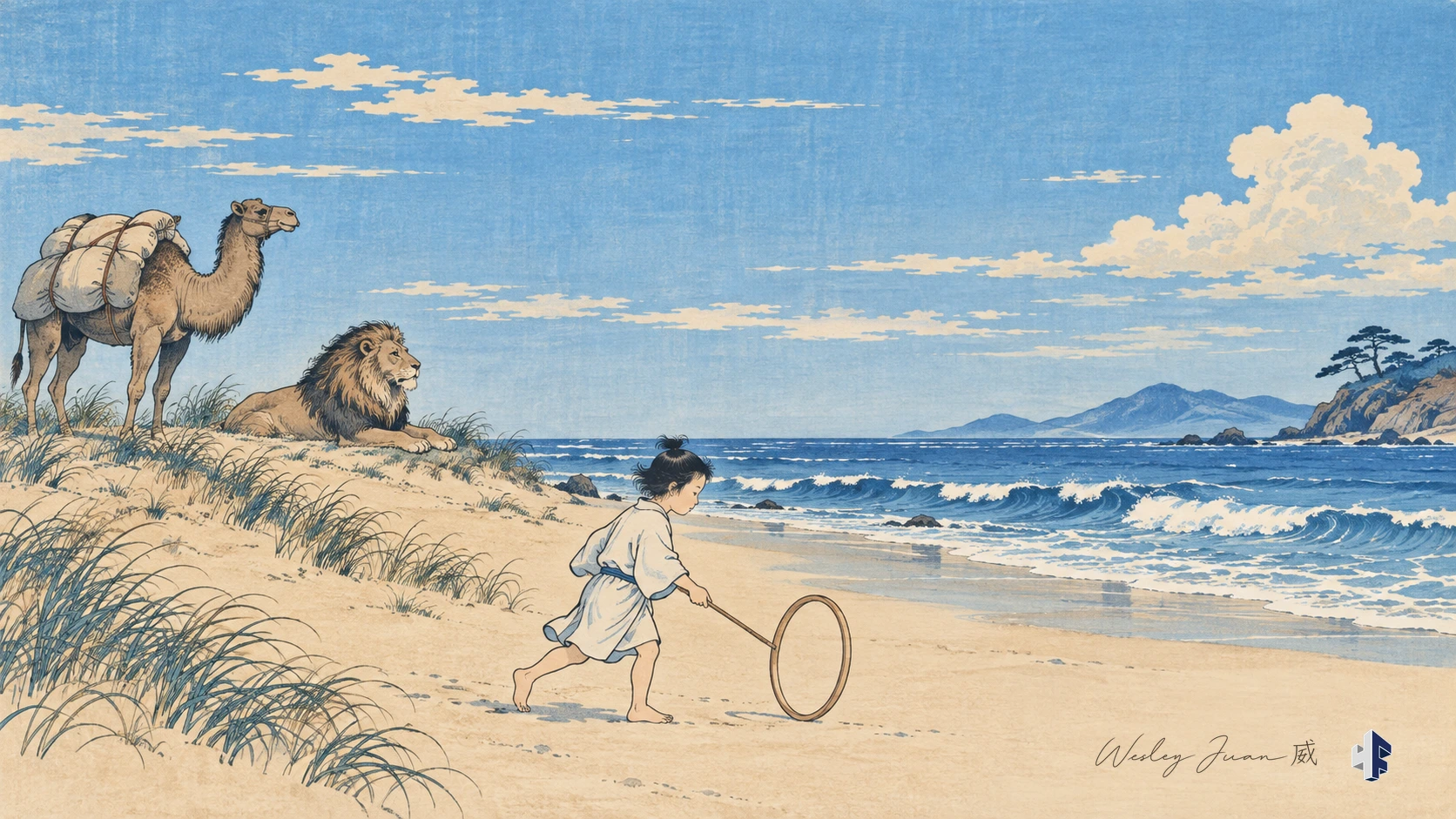
In Thus Spoke Zarathustra, the three metamorphoses of the spirit arrive in order: the camel, the lion, the child. It’s a philosophical parable Nietzsche gives a character in the book to tell, not a ladder everyone has to climb on schedule as they age. Three figures, three different hard problems.
The camel can carry. The lion can refuse.
The camel takes on heavy loads and walks into the desert. The lion faces the great dragon that stands for every existing command and fights for its own freedom. But the parable is clear that the lion cannot yet create new values. What it does is clear room for new creation.
So the story turns to the child: a new beginning, play, and a yes. The child here is a figure for what lets creation happen, not for ignorance or willfulness.
Remember only the lion, and it’s easy to take freedom to mean endless resistance. The turn Nietzsche leaves us is sharper: once the old commands stop deciding for you, are you ready to start something of your own?
Push against a standard and it can still pull you along
Picture a creator who’s tired of every video being measured by its view count and decides to stop chasing trending topics. The refusal is necessary. It lets him rearrange his attention.
But if, from then on, every topic he picks only has to answer “Is this anti-mainstream enough?”, the trends are still deciding for him. The answer is just flipped.
The questions that really need opening up are different ones. What has he been curious about for a long time? What does he want to make clear? What kind of relationship does he want his work to build, and with whom? Refusing clears the table. What goes on it next still takes a concrete choice.
Once you’ve won back the space, save a little strength to start what you actually want to do.
Back at Mental Gym: you’ve stopped doing it the old way. Now what?
In a sparring session, I’d ask: if you don’t want to follow that standard anymore, what do you want to try?
Back to that creator. He’s done chasing trends, but what’s the next video? There’s a topic he’s always wanted to shoot; he just figured no one would watch. Now we can talk about what draws him to it and how he’d want to shoot it.
If he doesn’t know yet, we stop there. You can turn down a demand and figure out the alternative later. When he’s ready to start, we’ll think the idea through together.
What if the thing you love is trending?
A while later, he notices that the topic he really wants to shoot happens to be trending. Does he drop it? If he can’t shoot it just because everyone else is, “anti-mainstream” has become another command.
He can love a niche topic. He can also love the same thing as a lot of other people. The question to press is which reasons in this choice are his own, and how much energy is going into proving “I’m not like everyone else.”
In the end he shoots the trending topic anyway. Halfway through, he realizes what he cares about is one detail hardly anyone mentions. Whether the video will do well, he doesn’t know yet. But this time, he has something he wants to say.
Once you stop measuring your work by views, what kind of experience of making things would keep you wanting to shoot the next one?
Your notes and saves (optional)
Keep a version of your own.
Saved only in this device’s browser and never sent anywhere. Other devices won’t see it, and clearing your browsing data erases it.
Further reading and sources
- Nietzsche: Thus Spake Zarathustra, The Three Metamorphoses ↗
Read the original “The Three Metamorphoses” in Part One (Thomas Common’s English translation). This piece only summarizes the parable, and I added the creator example. The editor’s commentary at the back of the book is not treated as Nietzsche’s own words.