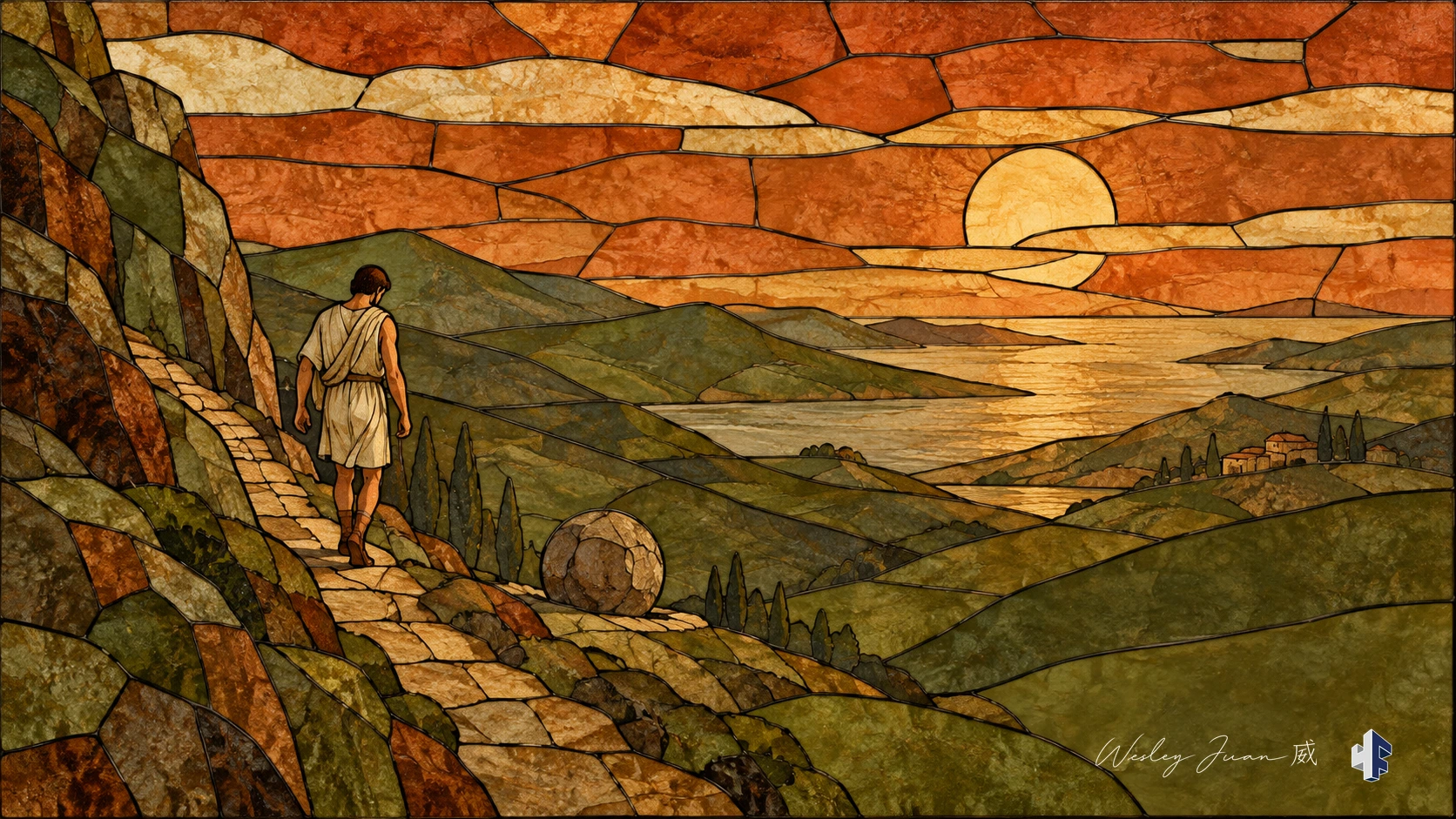
In Greek myth, Sisyphus pushes a boulder up a mountain again and again, and again and again it rolls back to the bottom. In The Myth of Sisyphus, Camus rereads the figure and looks hard at one moment: the walk down, when Sisyphus knows he’ll have to do it all over again. It’s a philosophical reading of a myth, not a story about grit finally paying off.
He never sees the rock stay at the top
Camus’s absurd lives in a tension: people long for the world to make clear sense, and the world gives no answer to match. Sisyphus’s situation turns that question with no ending into a picture you can see.
What Camus values is lucidity: knowing your situation and still living, still in revolt, without asking a guaranteed happy ending to vouch for the present. The happiness he writes about isn’t the same as a good mood. It’s certainly not a formula where you spot the absurd and joy arrives automatically.
Before you carry the myth home, mind the differences
Someone clears the same dinner table every day, and as soon as it’s done there are new cups. Someone finishes revising a draft, and the next day finds something else they don’t like. Repetition like this makes you ask: when does it actually count as done?
But everyday repetition isn’t the same as the futility in the myth. Once the table is cleared, someone can sit down and eat right then. A revision may really make the meaning clearer. “Never done for good” and “does nothing at all” are different judgments.
We can borrow the rock to ask questions, but we shouldn’t sentence every task to meaninglessness. First look at what it concretely brings. Then check whether you’re asking it for an oversized guarantee, one that promises nothing will ever be lost again.
Without a guaranteed happy ending, you can still take this step seriously.
Set aside “just hold on till the end” for now
In a sparring session, pick something you keep doing over and over and ask: if this can’t guarantee I’ll end up as a certain kind of person, which parts of it do I still want to put myself into now?
The answer might be a relationship, or one movement done with real care. Or you might find there’s nothing, and you’ve kept going only because you’ve already put so much in. Both answers deserve a hearing. Don’t force poetry onto every day just to live up to a philosopher’s image.
Then ask which burdens can be lightened and which arrangements can change. Daily life may offer tools, companions and a way out. Admitting there’s no ultimate guarantee doesn’t require you to stop dealing with what can be changed right in front of you.
Lucid doesn’t have to look like always upbeat
Use Sisyphus to tell an exhausted person “just look on the bright side,” and you’ve turned their trouble into a pretty line for yourself. The myth can’t excuse a concrete unfairness. Nor does it make resting, asking for help or leaving any less brave.
There will still be cups to wash tomorrow. Tonight, though, agree to take turns clearing up. Seeing repetition in a new light and taking some needless weight off your days can happen at the same time.
When the rock rolls down again, don’t rush to make yourself smile.
This time, I want to watch him walk down a little longer.
The table you clear every day will be a mess again tomorrow. If you stop expecting it to stay tidy forever, how will you decide how much effort it gets from you today?
Your notes and saves (optional)
Keep a version of your own.
Saved only in this device’s browser and never sent anywhere. Other devices won’t see it, and clearing your browsing data erases it.
Further reading and sources
- Stanford Encyclopedia of Philosophy: Albert Camus ↗
See section 1 on the concept of the absurd and section 3.4 on Sisyphus, lucidity and happiness. I added the everyday examples and the practice.