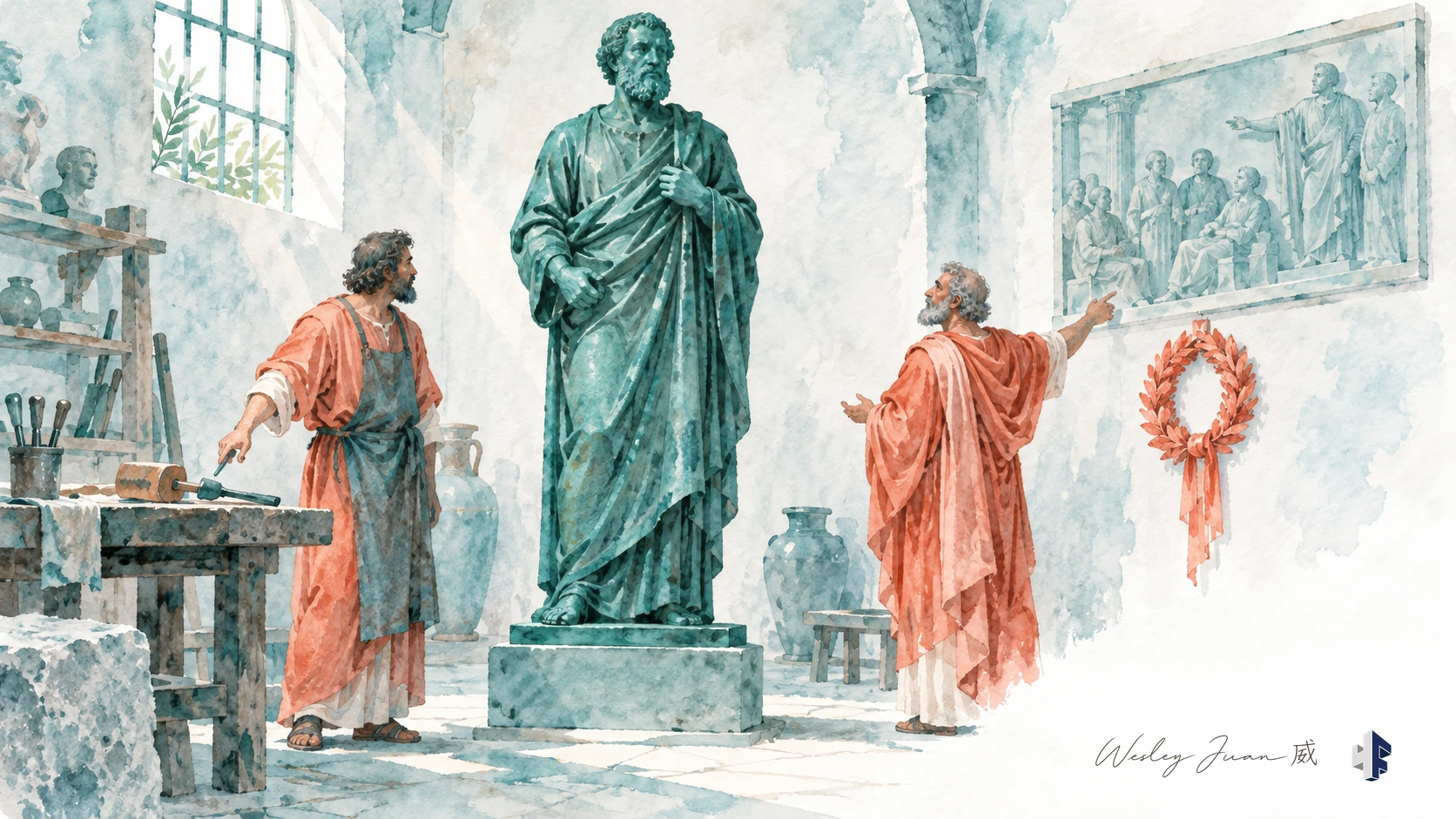
In front of you stands a bronze statue. One person says it’s here because a sculptor made it. Another says it’s here because someone wanted to remember something. Two different answers, and both can stay in the room.
First, stop in front of a statue
Aristotle’s four causes sort explanation into several directions: the material a thing is made of, the form that makes it this kind of thing, the agent that brings it about, and the end it is aimed at. The bronze statue is a classic way in to the distinction.
“Cause” here doesn’t quite mean the single chain of before-and-after we have in mind when we use the word today. It also asks why a thing is the way it is, and how it holds together. The four causes can’t be lifted straight into modern science as an all-purpose causal model, and we shouldn’t assume that everything that happens by chance has a purpose.
For now, keep one reminder it hands us: once you’ve asked why, check which kind of explanation you’re waiting for.
Turns out we weren’t answering the same question
Picture a handmade wooden chair. Ask why it was made this way, and one person talks about the strength of the wood, another about how well it stacks, another about the designer’s trade-offs, and someone else about the small reading room it’s meant for.
This is a present-day scene we’ve drawn from the four causes. The answers can fill each other in, and they can also collide. Change the shape so it stacks, and it’s less comfortable to sit in; if the wood needs special care, the setting you had in mind has to be rethought.
More reasons aren’t automatically better. What matters is seeing where they join up. When someone ends a discussion with “because it looks better this way,” what usually goes unanswered is use and limits. Nobody is failing to understand beauty.
Sort out which kind of why you’re asking, and the answers stop crowding each other out.
What kind of problem is a small crowd?
Only a handful of people came to the gathering. One person blames the promotion, another thinks the timing was off, but the host says that for once, everyone got heard all the way through.
Time, place and how people were invited all affect how many come; and whether the goal was a lively crowd or a deep exchange changes whether “too few people” is a problem at all. Causes and verdicts are crammed into the same complaint.
This is the earlier distinction put to further use. Each explanation still has to be checked on its own. A full set doesn’t mean you’ve answered for that evening.
Purpose helps, and it can be written in too late
After something happens, it’s easy to find a reasonable-sounding use for it. A space nobody planned properly gets described later as deliberately left flexible; a result that showed up by accident gets written up as foresight.
When you talk about purpose, separate the original intention, the actual function and the explanation after the fact. The three can differ. Getting this straight keeps you from repeating something next time by following an after-the-fact story, without knowing what conditions success actually needed.
The question Aristotle left us is bigger than a table with four boxes filled in. What we practice day to day is this: when answers differ, first check whether the questions point in different directions; when answers are too tidy, check what might have been left out.
About the same chair, one person says its shape is for stacking, another says it comes from the limits of the wood. What different questions would each explanation lead you to ask about the next chair?
Your notes and saves (optional)
Keep a version of your own.
Saved only in this device’s browser and never sent anywhere. Other devices won’t see it, and clearing your browsing data erases it.
Further reading and sources
- Stanford Encyclopedia of Philosophy|Aristotle: the four causes ↗
On the four causes and the bronze statue example. The wooden chair and the gathering are my additions.