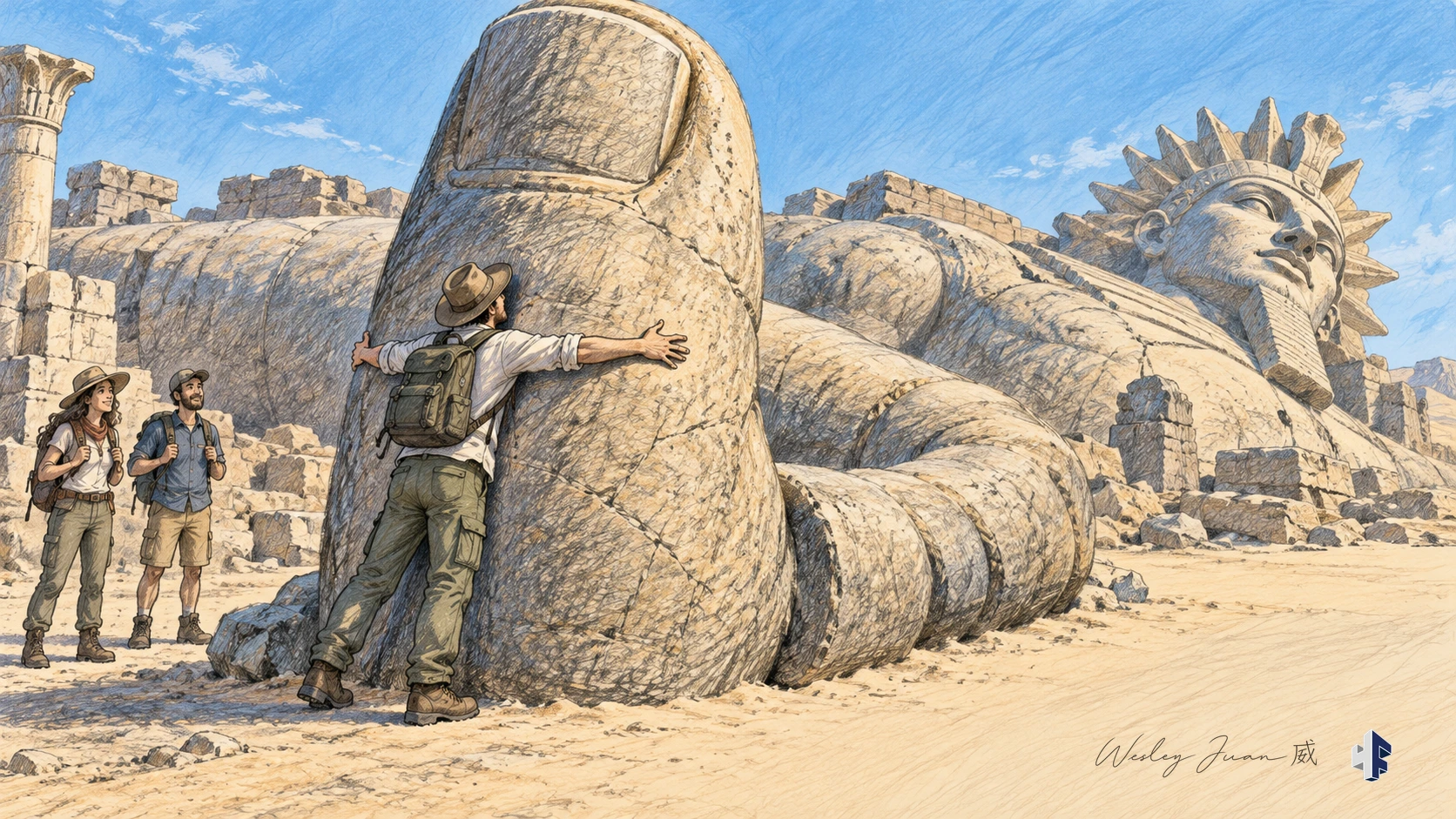
A man spreads his arms and presses his chest against it.
Left hand, a little farther.
Right hand, same.
Still short.
He tries another angle, cheek against the bronze, shoulders straining forward.
The man beside him watches for a while.
“My turn.”
What they’re hugging is a thumb.
The sun god’s thumb.
The god is lying on the ground and shows no sign of helping.
When the ancient writer Pliny described the Colossus of Rhodes, he made a point of recording this: few people can get their arms around his thumb.
So there are at least two parts to this.
One: the statue really was enormous.
Two: people really did go and hug it.
As for why a god that big was lying on the ground, that story starts with a man who couldn’t get into the city.
In 305 BC, Demetrius brought an army to besiege Rhodes.
The troops came, and so did the siege engines. Those things had to be shipped in, assembled and pushed up to the walls. The people inside watched them creep closer and had to work out how to survive today before worrying about tomorrow.
After about a year of fighting, the city still hadn’t fallen.
Demetrius pulled out and left a load of siege engines behind.
The Rhodians walked out through the gates.
The machines that not long ago had been trying to tear down their homes were now parked outside, and nobody wanted them.
Sell them.
And the money?
Build a god.
According to ancient sources, the money for the Colossus of Rhodes came from selling those siege engines.
If Demetrius ever got the news, he’d probably have needed to hear it twice.
The siege engines I paid for.
The city I couldn’t take.
They sold the engines.
And built themselves a monument.
A big one.
Chares of Lindos, a sculptor, took the job. It took him twelve years.
Twelve years is long enough for the kids gawking at the building site to grow into young men. The god was still under construction. The bronze took shape section by section, with huge stones packed inside to steady the weight.
When he finally stood, he was about thirty-three meters tall.
If you stood at his feet and wanted to tell him something, you’d have to tip your head all the way back first.
Whether he was listening was another matter.
He stood for a little over half a century.
Then came the earthquake.
The sun god snapped at the knees and fell to the ground.
Something that took twelve years to stand up doesn’t need twelve years to fall down.
The people of the city had their own damaged homes to deal with, and now a god lying on his back.
Should they stand him up again?
A short question. A very long construction job.
But according to ancient sources, an oracle forbade rebuilding him.
So the sun god stayed as he was.
He had been made to stand and be looked up at. Now people could walk right up beside him and study him.
Where he’d broken, huge hollows gaped open, with stones visible inside. Everything that used to be hidden in the bronze was out in the open.
Some people looked at the face, some at the break, some went to see the hands.
And then there was always someone who spread his arms.
If he were set back up, all these people would be back to craning their necks.
As it was, you could even check, in person, how thick a god’s thumb is.
The man who can’t reach steps back. The next man looks at his own arms and figures the last guy must have been doing it wrong.
His turn.
The sun god didn’t get up today, either.
But there’s always somebody busy beside him.
As for where he finally ended up, later ages booked him a trip.
In the story, the Colossus’s scrap bronze was sold to a merchant and carried off on nine hundred camels.
Nine hundred camels.
At this point, you really want to see the packing list.
How many bundles for the head?
And the hands?
That thumb nobody could get their arms around: which camel got it?
The story doesn’t say. It just leaves a caravan long enough to think it over slowly.
A camel kneels. Men load the cargo, balance the weight on both sides, pull the ropes tight and move on to the next one.
This load is the sun god.
So is the next.
The camel just stands up.
Wesley murmur
Fifty-four years standing, eight hundred lying down. This god spent most of his career lying down on the job.
But I love that thumb.
When he was standing, all you could do was look up: “Wow, that’s big.” Once he was down, you could walk right over: “No way I can’t get my arms around that.”
And people would line up behind you.
You spend twelve years building a god, and what everyone ends up playing with is the thumb. Any product manager reading this should hold off on the fix.
The oracle’s “don’t rebuild” might be the best product call in history. Stand him back up and you kill the most fun feature.
And who paid for this god, anyway?
The enemy.
Someone comes to attack you, fails, and the gear he leaves behind pays for your monument. What a rival drops on his way out can turn into your asset the moment you look around.
If I were Demetrius, I’d at least ask for one line carved on the base: Thanks to our sponsor.
Your notes and saves (optional)
Keep a version of your own.
Saved only in this device’s browser and never sent anywhere. Other devices won’t see it, and clearing your browsing data erases it.