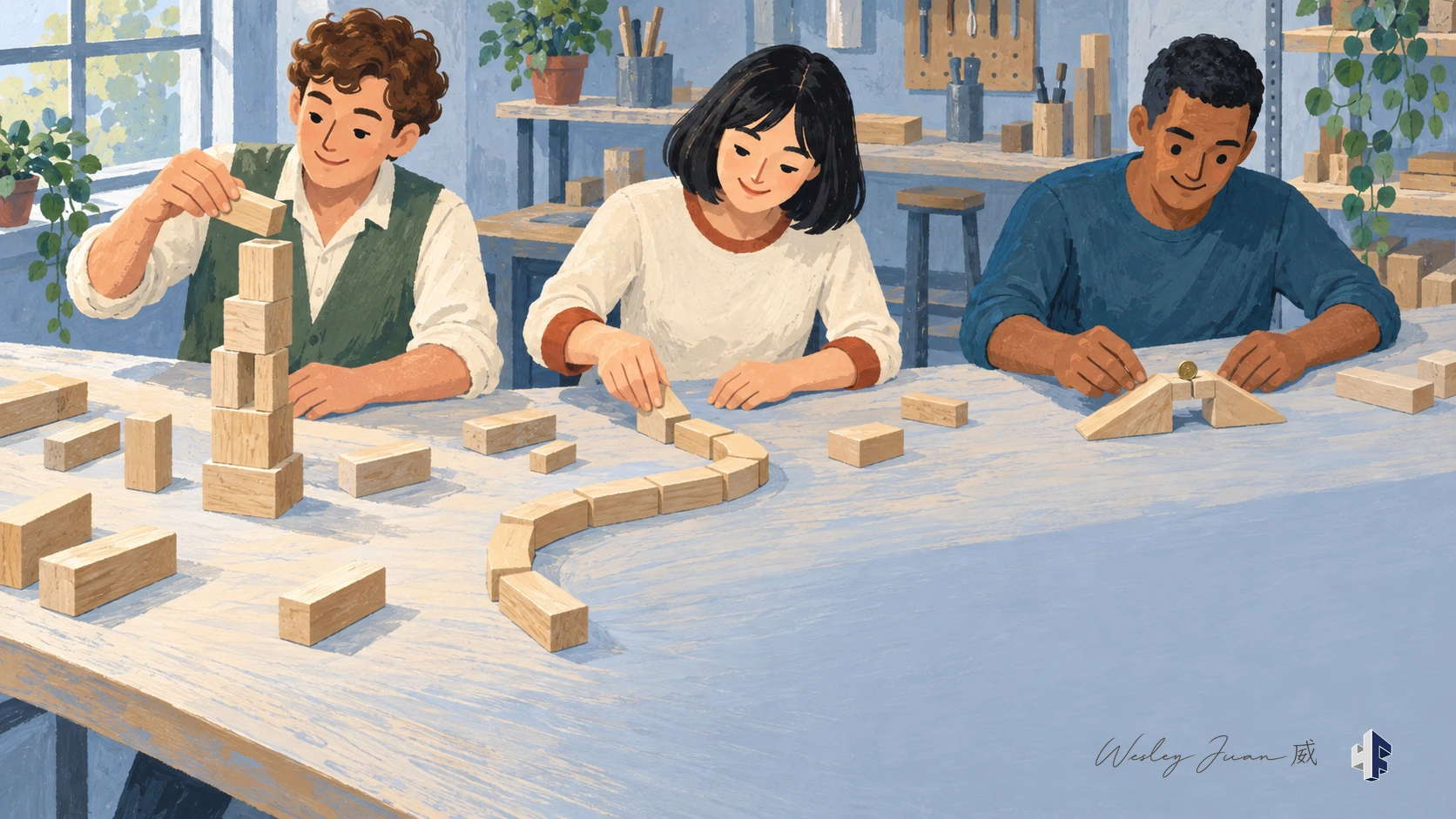
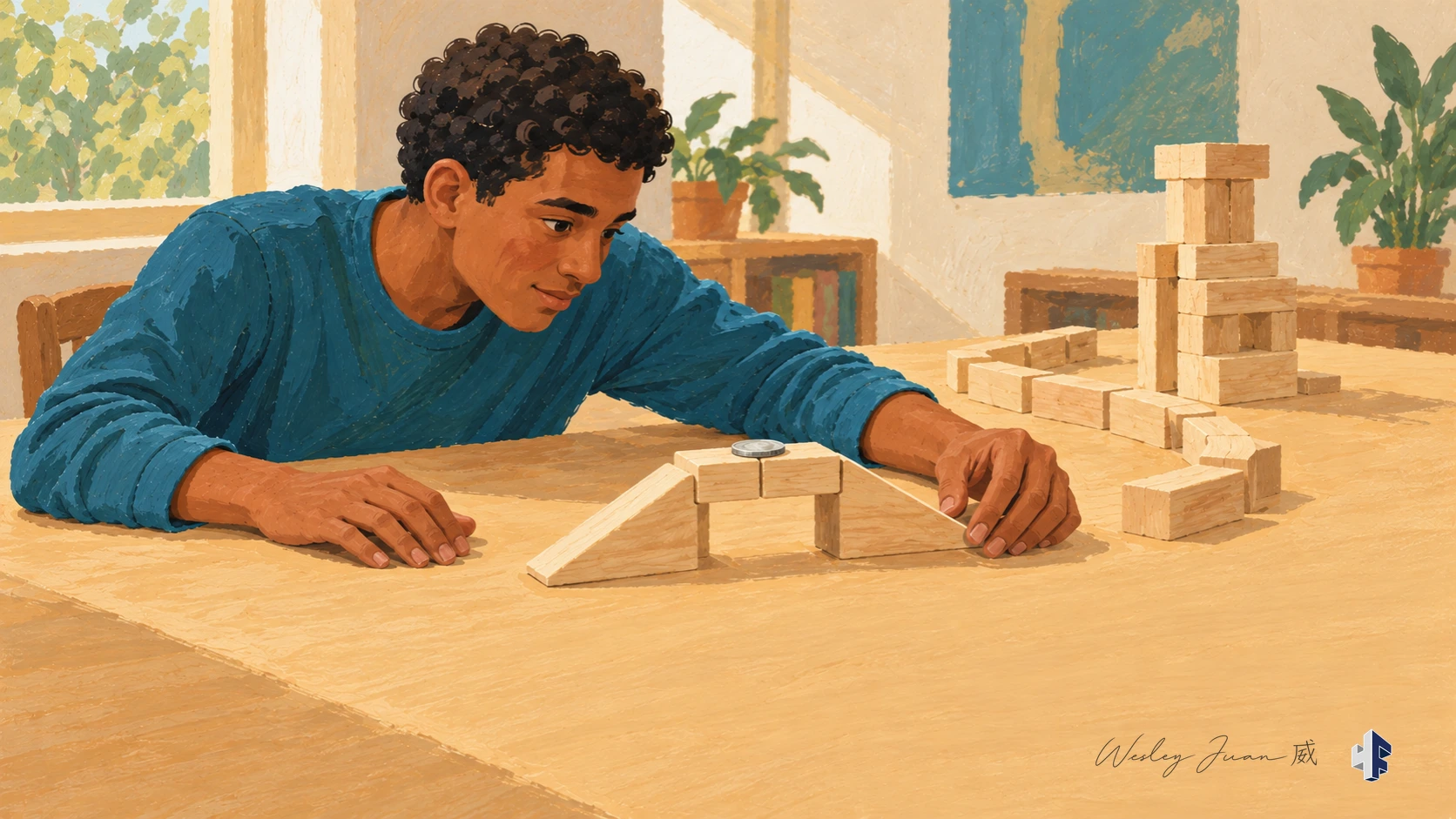
There are only a few blocks of wood on the table. One person stacks a tower, another lays out a road, and someone uses two of them to build a bridge for a coin. Same materials, but once a few pairs of hands get to work, the table no longer looks just one way.
Are you handing out materials, or a finished product?
When we design an event, it’s tempting to look after the experience all the way to the end. What to say at the start, which step comes next, which takeaway people should ideally walk away with: all of it arranged in advance. It’s controllable, and it’s easy to check whether the program got done.
But some events are valuable precisely because people make things you didn’t see coming. You give everyone the same materials and clear limits, and let them decide how to combine them. A sheet of paper can be folded, rolled, or turned into a support; you don’t need to list the shape of every bridge in advance.
Then the designer’s job shifts a little: what has to be fixed first, so everything else is free to vary?
Clear limits give every attempt something to lean on
If, halfway through a game, the host suddenly says that last move doesn’t count, players lose track of what their next move is even testing. The trouble is that the rules were never made clear, or the host doesn’t like surprises.
Flip it around. When everyone knows the materials can’t be glued to the table, every bridge has to span the same gap, and each one must hold the same coin, different approaches become comparable. Someone widens the base, someone changes the fold, and failures start bringing back information.
Boundaries give every attempt shared ground. They can still change, but the change has to be announced, so players know they’re now playing a different version and don’t have to move forward by reading the host’s mood.
Draw the lines clearly, and the answers get a chance to go past what you imagined.
One more option isn’t one more layer of depth
If, before anyone has figured out round one, you add ten materials, five scoring systems, and three special items, the table gets busier but the choices don’t get more interesting. People are too busy memorizing rules to understand why their approach works.
First see whether the few original materials already play off each other in interesting ways. Fold the paper thicker and it holds more weight but spans less distance; add a support and it gets steadier, but eats into a limited supply. Those linked trade-offs are what give a choice something to think about.
Simple isn’t automatically a virtue, either. If everything you try turns out about the same, or one obvious answer shows up fast, a handful of rules is just as boring. What matters is what they let happen.
Treat the surprise as a reply
When it’s over, look first at what people did, then at what you hoped they would do. Did anyone find a new combination? Did two people pick different approaches for different reasons? After failing, did anyone want another go?
None of that proves the design worked, but it tells you more than “everyone followed the steps.” If nobody wants to try again, the limits were unclear, the feedback was too slow, or the problem itself wasn’t compelling. A beautiful concept still has to take that kind of disappointment.
You can write the rules for a world without deciding the final shape for every pair of hands. The best moment in design is standing off to the side and watching someone do something you never planned that makes complete sense.
Someone plays in a way you never designed. On what basis would you decide whether to keep that surprise or step in?
Your notes and saves (optional)
Keep a version of your own.
Saved only in this device’s browser and never sent anywhere. Other devices won’t see it, and clearing your browsing data erases it.