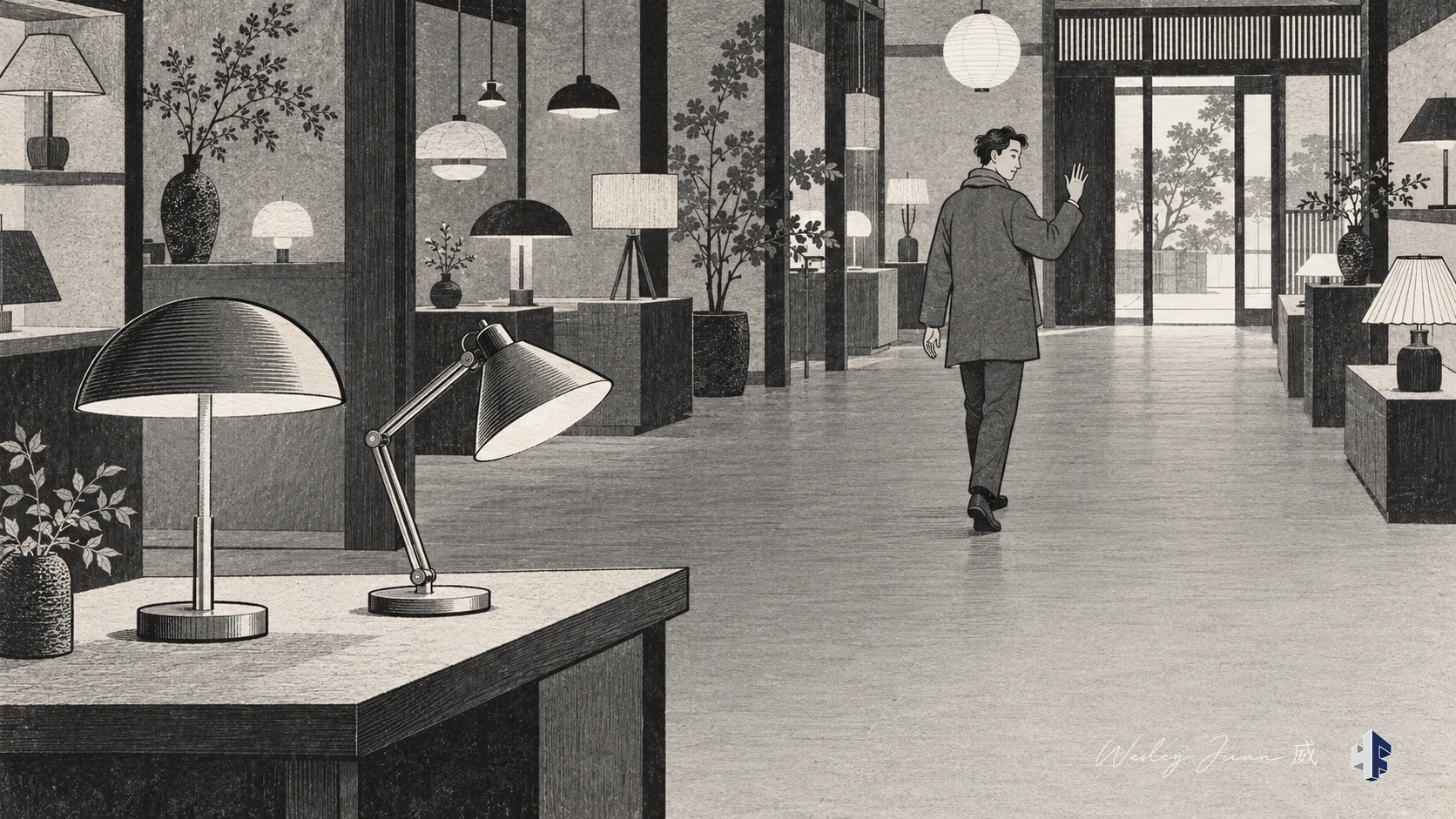
Picture a lighting brand. On a Saturday afternoon, someone walks into its store and studies two lamps side by side for a long time, asking about the light, the size, the warranty. Then they say thanks and leave. At the end-of-month meeting, that afternoon gets counted as a visitor who didn’t buy. The rent, meanwhile, shows up on the books in full.
Start with a perfectly reasonable decision
If a store has gone a long time without selling enough to cover its costs, shrinking it or switching to appointments only both belong on the table. Resources are finite. Keeping this store means less money for product, after-sales service or other channels.
So here’s the first judgment: people can buy on the website anyway, and the store barely makes a sale, so move the budget somewhere that brings in orders more easily. It’s a tidy sentence, because it quietly carries an assumption: a store’s job in the business is to take money on the spot.
If the assumption holds, the decision is sound. But did the person who looked at the lamps and walked out really leave with nothing?
No lamp, but they left with a comparison
Some people are just browsing. Others go home, measure their desk, and then order on the website. In the store they saw the same lamp at different brightness levels, checked whether the base would hog the desk, or realized for the first time that what they cared about was how far the light reached. These are possible routes. They don’t license you to rewrite everyone who walked out as a future customer.
Once you admit these routes need checking, the original math has to ask one more question: if the store disappears, do some of the online orders change too?
Where a sale lands on a website is easy to record. The process that gets someone to start considering, to trust, to know how to compare, is scattered all over. What you see is the final click; the credit belongs to the whole process. So the first judgment needs revising: no sales in the store doesn’t, on its own, prove the store contributed nothing.
A contribution you can’t see still needs checking. Invisible doesn’t mean exempt.
This far into the store’s defense, it’s time to pause
From here it’s easy to swing to the other extreme: the store carries the experience and the brand, it can’t be measured in numbers, and it shouldn’t be cut lightly. What does that sentence protect, and who does it excuse from answering questions?
If every space can be saved by “value you can’t see,” the team loses the ability to tell a store that genuinely helps people choose from one that’s merely expensive and nobody wants to walk into. Hard to attribute doesn’t mean the contribution is large. And even if the store is useful, that doesn’t automatically beat every other use for the money.
Even a store that does contribute might be too big, too far out, or only need to open three days a week. Proving a function exists and proving the current setup should stay are two separate questions. Defending something that’s been overlooked doesn’t exempt every one of its expenses from review.
Turn two too-easy answers into questions you can check
Start by pinning down what the space is actually supposed to do. If it’s there so people can compare light, watch whether visitors really use the displays. If it’s there to answer installation questions, look at which questions only got cleared up in person. Don’t draw up a long list of handsome functions and then assume every one of them is happening.
An optional “How did you hear about us?” at checkout can give you clues, but memory and self-reporting both have limits, so when you split the credit it’s a rough reference at best. Before-and-after sales comparisons get muddied by the season, product changes and promotions. Every way of checking has its edges. The point is to give the next judgment a little more checkable ground than the last one had.
If you want to cut the store’s hours, pick a limited window and watch appointments, inquiries and purchase paths, instead of changing the products, changing the prices and closing the whole store at once, then guessing from total sales which move made the difference. Even then, a small test struggles to say much about long-term brand effects. Leave what you can’t answer yet unanswered. Don’t fill it in with a nice story.
The line we’re left with isn’t so convenient
The original line was “No sales, so we can pull it.” Once you find a counterexample, swapping in “It creates an experience, so we should keep it” is just another slogan. The judgment that holds up goes like this: figure out which jobs the store is doing and what evidence backs that up, then see whether those jobs could be done at a better cost.
If the displays really do help people choose, that function goes back into the decision. If a smaller space or an appointment system can do the same job, there’s no need to cling to the original storefront to protect it. And the other way around: if nothing seems lost right after scaling down, that doesn’t instantly prove the past spending was worthless, because effects can show up late.
The Saturday customer never bought anything. We don’t have to invent a late order for them to make the question stand. As long as we stop closing the case on that whole afternoon with “no sale,” and stop using “value you can’t see” to renew the lease forever, the next discussion gets a more honest place to start.
A customer tries out a lamp in the store, then goes home and orders it somewhere else. What would the store need to have helped with for the brand to keep paying its rent?
Your notes and saves (optional)
Keep a version of your own.
Saved only in this device’s browser and never sent anywhere. Other devices won’t see it, and clearing your browsing data erases it.