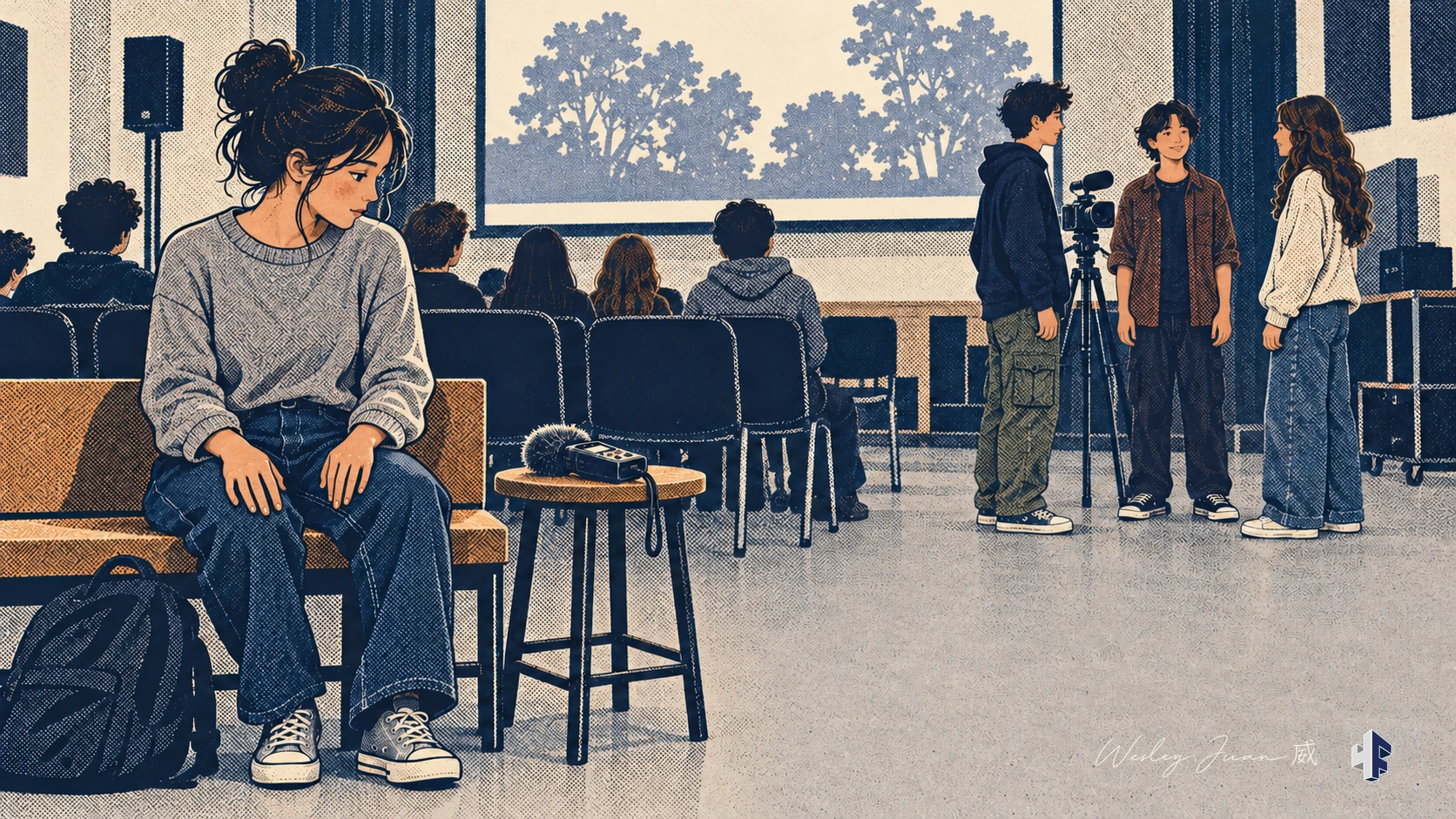
It’s the high school club showcase. A classmate’s short film, interviews around campus, has just finished, and people are already crowding around to ask if they can shoot with him next time. Halfway through your video, someone nearby whispers, “What did he just say?” You know the sound on that part is bad. But suddenly it feels like it’s not just the video that fell short. You’re standing outside that noisy circle too.
How one bad audio clip became a verdict on you
There are two things you care about: you want your work understood, and you want your classmates to want you around. Both are real, but one answer can’t handle both.
Muddy audio, you can go back and trace. Nobody asking you to shoot with them right away, though, has lots of possible reasons: they were already close, or they haven’t thought about teaming up yet. Cram every reaction into “I don’t belong in this club,” and it’s hard to tell whether the next step is practice or speaking up.
Try writing the things beside the feeling a little smaller: The interview in this part is hard to hear. I want someone to ask me to work with them next time. Those two sentences don’t deny the disappointment. They give it two separate places where you can actually do something.
Inside the envy is something you want to learn
Your classmate’s work really is more polished. The opening grabs you, the interviewees sound natural, and the editing keeps the story moving. Admitting those strengths doesn’t automatically make your own effort worth less.
Pick one spot and look closely: what did he ask that got a shy person to keep talking? That question gets you closer to something you can take home than counting whose crowd stayed longer.
But your video can keep its own pace. You wanted to film the hallway slowly emptying after school; he filmed a loud ball game. Two kinds of work can move at different speeds. Be clear about what you want people to see, and you’ll know which techniques to learn and which not to carry over wholesale.
Other people’s strengths can be your textbook. Getting closer to the crowd doesn’t mean giving up your own curiosity.
One test recording, one invitation
Take one gap that really gets to you and find the part of it you can actually observe. “I have no talent” can’t be practiced. “The audience can’t hear the interviewee’s answers” can: before the next shoot, record a short clip and get a friend to listen.
If what you care about is being left out of the collaboration, you can make a specific offer: “Next time you film a game, could I help with sound?” Whether he says yes is another matter. It still gives you one more chance to connect than waiting for him to guess from your work that you’d like to get closer.
And don’t only show your work to people who’ll comfort you. You can disagree when someone says you’re not cut out for filmmaking, and still admit the sound problem they pointed out is real. One sentence can hold a judgment to let go of and a note worth keeping.
The hallway slowly empties
If your video needs the audience to follow the interviews, the sound has to pass first; “my style” comes after. Expression can vary; the work still has to give what it means to say a chance to reach other people.
Then again, getting the sound right won’t instantly make you the person everyone wants to work with. Friendship, rapport and shared interests are kept in a different ledger from the points your work scores. That doesn’t make the practice a waste. Learning a skill and building a friendship simply take different amounts of time.
The showcase breaks up, and the hallway slowly empties again. You remember this is exactly the moment you’d meant to film.
Somewhere down the hall, someone is stacking chairs. This time, you want to keep that sound too.
Watching everyone gather around your classmate’s work, you want to make your video better and you want to join them. What kind of response does each of those wishes need?
Your notes and saves (optional)
Keep a version of your own.
Saved only in this device’s browser and never sent anywhere. Other devices won’t see it, and clearing your browsing data erases it.