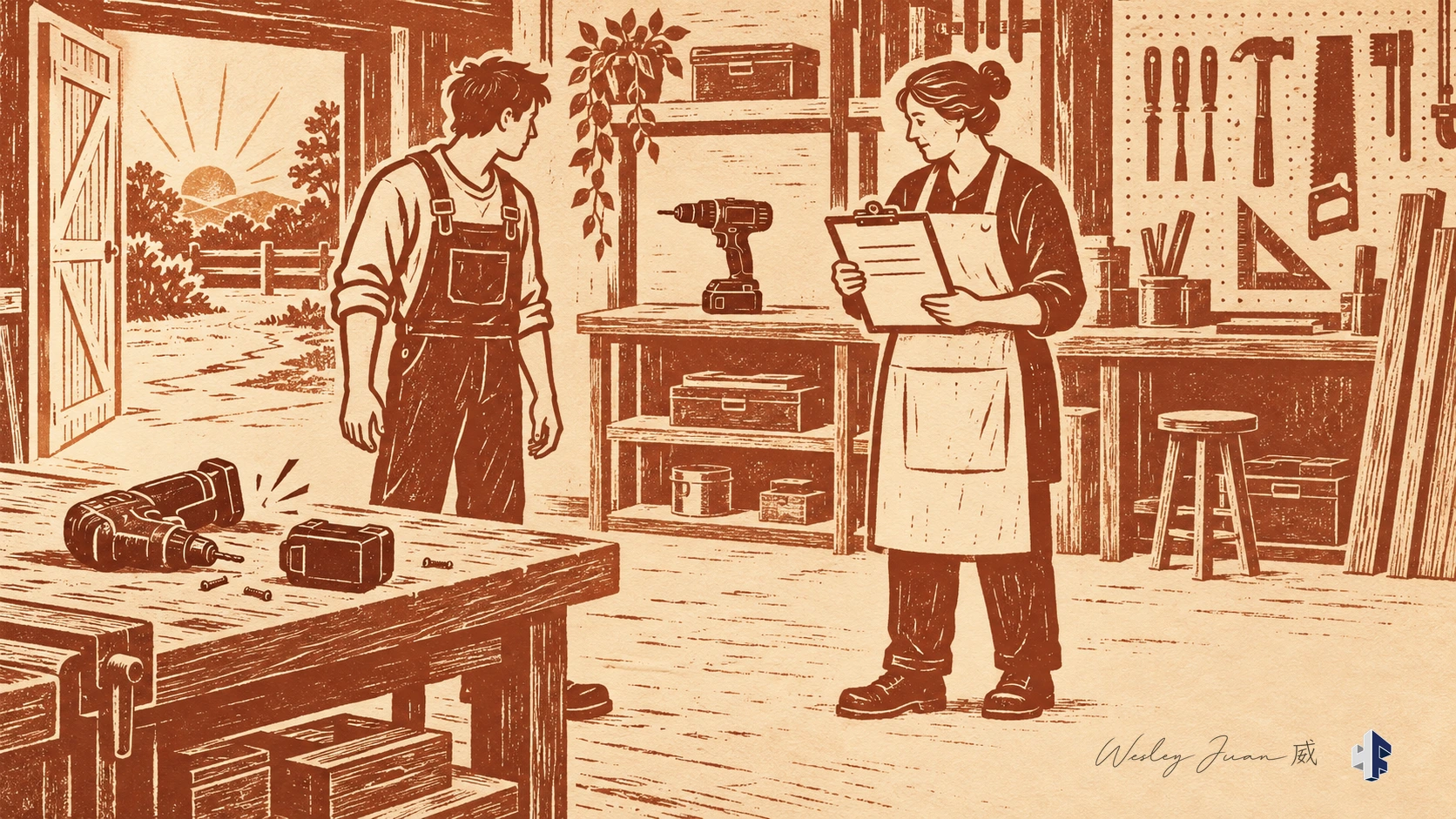
Picture a shared studio where you have to sign up a day ahead to borrow equipment. One morning, the gear you’d reserved suddenly breaks down, and another unit is sitting right there, free. The manager flips through the rules and says, “You can’t borrow it today. You didn’t sign up yesterday.”
First ask what the rule was meant to protect
Signing up in advance has good reasons behind it: avoiding double bookings, checking the equipment, arranging handoffs. Doing it the day before is how today runs smoothly.
But when something breaks without warning, following the rule to the letter defeats its own purpose. The equipment sits idle, the user’s work grinds to a halt, and the manager still has to deal with the gear they promised having failed.
So go back and ask: what can’t be skipped, the day-ahead format, or the checks that have to happen before anything goes out? If the inspection takes hours, there’s a concrete reason not to lend it yet. If the only difference is the date in a field, it’s worth asking what that format is protecting now. The reasons need to be asked about plainly, but a reason that doesn’t sound impressive is no excuse to skip a safety check that matters.
A door for exceptions is also a door for who you know
Realizing a rule is too rigid doesn’t mean you can fix it by leaving the call to the goodwill of whoever’s on shift. A familiar face gets the gear with one sentence; a stranger with the same reason gets turned away. The people who push get a pass, and the quiet ones don’t even know they could ask.
The exception seems to help the person in front of you, but it leaves everyone else unsure which agreement to trust. So the conditions need to be specific: the original booking can’t be honored because of a breakdown, the replacement has been checked, and no one else’s confirmed slot is taken.
You also have to settle who gets to decide. If you ask frontline staff to “be a bit flexible,” agree up front who shares the blame for overstepping with them when something goes wrong. A door that really opens needs real authority behind it, not just a friendly statement on the wall.
Make exceptions explain themselves, and let the ones that keep coming back change the rule.
Two people qualify. There’s still only one unit.
Push the scenario further. On the same day, two users’ reserved equipment breaks down, and both meet the conditions for borrowing a replacement. But there’s only one spare, and their working hours overlap.
At this point, “qualifies for an exception” hasn’t answered who gets it. Original booking order, who’s hit hardest, drawing lots, splitting the time: each one protects something. Deciding on the spot by who sounds more urgent shortchanges people who aren’t good at making their case. Strict first-come, first-served ignores whoever faces a loss that can’t be undone.
No single word makes the trade-off go away. Whoever decides has to explain which principle they chose, which information actually bears on this allocation, and what the other person gets to make up for it. Not every grievance can be resolved, but “we’ve heard your concerns” and “we’ve dealt with what this cost you” are two different things.
What can the person who was turned down come back with?
If all a decision leaves behind is “approved by manager,” nobody else knows how to challenge it. A more useful record says what happened, which conditions were met, which allocation principle was used, and who can review it. Making the general principles public doesn’t mean posting everyone’s work details or personal difficulties.
A review needs a time frame too. If the equipment is needed this afternoon, an appeal answered three weeks later might improve the process for next time, but it can’t give back today. Separate the urgent sorting-out in the moment from the review of the system afterward, so people know what each one can handle.
If someone brings new information, say, that the other unit can actually be fixed quickly, the allocation should be reopened. Repeating the same complaint, though, shouldn’t leave every confirmed arrangement hanging indefinitely. Room for objections and predictable outcomes have to be designed together.
When exceptions keep coming, the rule is calling for help
If the same breakdown-and-borrow happens every week, it shouldn’t keep being logged as a one-off favor. Go back and look at whether maintenance, booking promises and backups are enough, or whether costs that were always going to happen are being quietly pushed onto users and whoever’s on shift.
On the other hand, not every rare case deserves its own full-blown policy. Every new condition is something someone has to understand and enforce. Note which exceptions keep recurring and which ones have big consequences, then decide which layer to change. That’s more workable than writing every possible accident into a thick rulebook in advance.
Behind the door there needs to be a person, and a reason. The person can’t make the reason disappear, and the reason can’t make the responsibility disappear. That’s how a rule gets a chance to correct itself against reality, instead of chalking up everything nobody thought of to users who wouldn’t cooperate.
Two people’s equipment has broken down. Both qualify to borrow a spare, and there’s only one left. What way of allocating it could you defend?
Your notes and saves (optional)
Keep a version of your own.
Saved only in this device’s browser and never sent anywhere. Other devices won’t see it, and clearing your browsing data erases it.