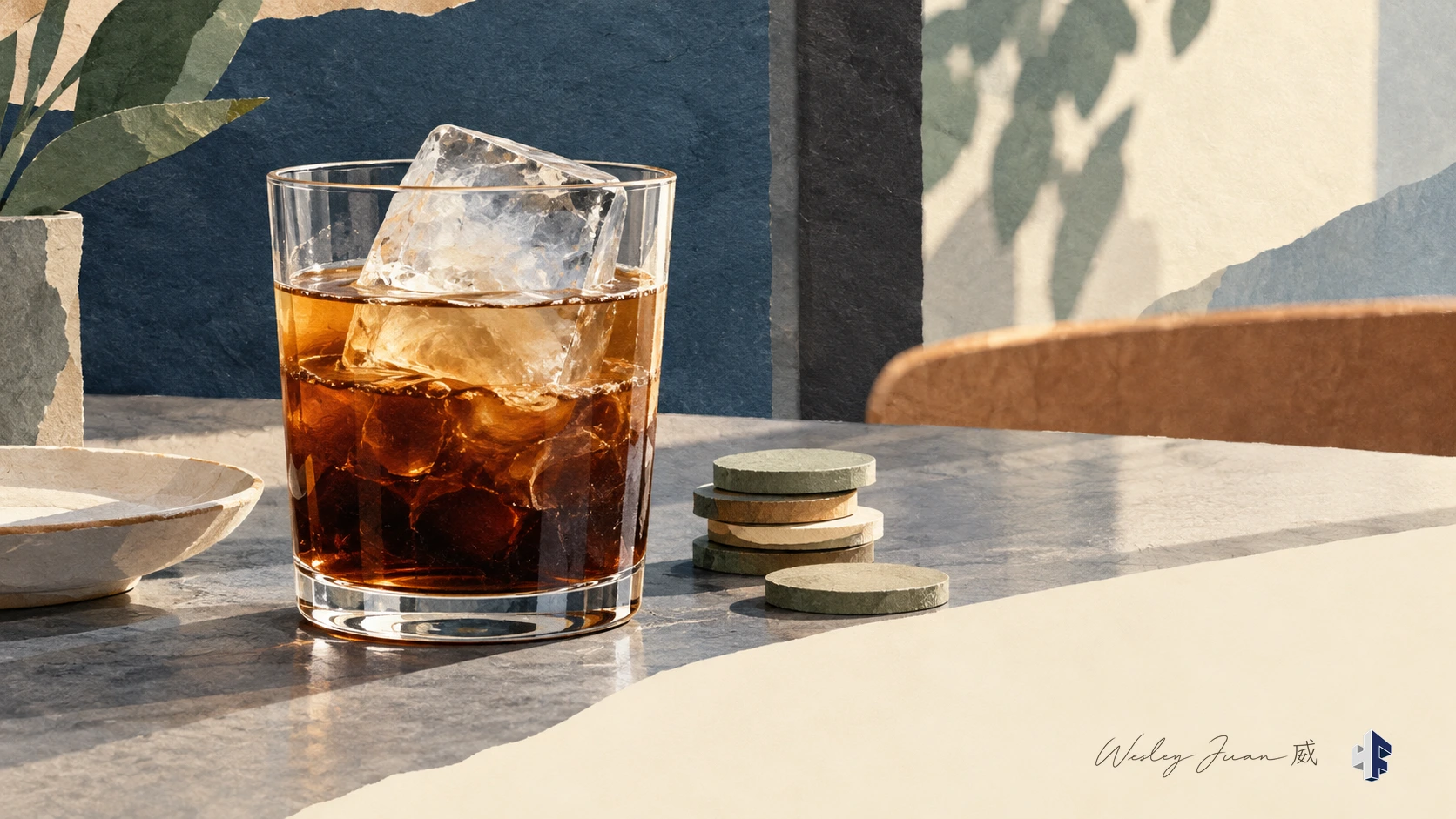
At the counter, a drink loses its ice and gains an empty space. Filling that space costs NT$15. The customer was choosing an ice level. Now there is another question: what, exactly, was included in the cup I paid for?
Find the action that carries the charge
Liberty Times reported that the new policy took effect on October 12, 2026. After ordering less ice or no ice, topping up with milk or another drink costs NT$15 per cup. Removing ice and topping up the cup are separate actions. Reducing the story to “no ice costs extra” changes the charging condition.
The disputes reported by FTV and NOWnews concern the volume left when a no-ice drink is not topped up. Before judging the charge, write down the original drink, what was removed and what would be added. Filling those three spaces helps establish which drink the argument is actually about.
Keep the ingredient calculation with the ingredients
Ice takes up part of a cup. Removing it and adding milk or coffee increases the quantity of those ingredients. There is a cost argument for charging more. But these reports do not provide every recipe, the extra milliliters or ingredient unit prices. We do not have a table that calculates each drink’s incremental cost.
An Americano raises a further question. Espresso, water and ice form a different combination from a milk drink. Treating every top-up as the same action hides the difference in ingredients. A uniform charge can be questioned without inventing a cost figure and calling it proof that NT$15 is excessive.
The customer is settling another account
Starbucks’ appeal includes a third place outside home and work, together with customized service. Sitting for an afternoon, changing the ice level or choosing oat milk, and hearing “Would you like a little more caramel?” all help explain the price a customer accepts.
Cost justification and a suitable brand decision need separate arguments. When a brand earns a premium through service, attaching individual prices to actions customers understood as care invites them to reconsider that expectation.
A credit limit offers a way to think about brand premium. Customers pay more partly because they expect a certain kind of treatment. This is an analogy for understanding a decision. It provides neither a churn rate nor a count of customers who have left because of the change.
What a competitor said with a cup
In a 2011 short film, Luo Yonghao pointed to the middle cup and asked for a medium. The barista repeatedly corrected him: it was a large. In March 2026, Luckin brought the same barista back for a new version. This time the sizes were explained clearly, and Luo ordered five extra-large drinks.
Put the scenes from the two films side by side and compare how each brand handles friction. One cup label creates a problem; another brand makes clarity and quantity part of its pitch. The two films can be compared for how they communicate. Measuring sales caused by them requires separate data.
Keep the dates on operating figures too. Luckin reported RMB15.29 billion in net revenue for the third quarter of 2025, growth of 50.2%, and 29,214 stores. Starbucks’ joint venture agreement with Boyu Capital concerned up to a 60% stake in its Chinese retail business, valued at US$4 billion. Store expansion, revenue growth and an equity agreement belong in separate columns before they become a single story of winning and losing.
In a comparison table, give year, currency and period separate columns. Luckin’s figure is quarterly revenue; the Taiwan Starbucks figure discussed below is annual revenue. To compare renminbi and Taiwan dollar amounts, first use a common currency, then compare figures from the same period. Keep these differences visible before deciding whether the comparison concerns scale, growth or customer choice. If the fields do not align, leave the figures as separate background rather than turning them into a ranking.
A rising share price does not answer the customer
In Taiwan, Knews reported 2025 Starbucks revenue of NT$16,300,000,000 and profit of about NT$680,000,000, with 614 stores at the time of reporting. It also quoted Uni-President’s chairman saying in May 2026 that Starbucks had never experienced a profit decline. These figures describe business scale and previous operations.
Competition needs a date label as well. A 2019 Business Next report recorded 480 Louisa stores, more than Starbucks, and about 600 million takeaway coffees a year in Taiwan. Those observations belong to 2019. They cannot serve as a current store census for the new policy.
On October 14, 2026, FTNN reported that Uni-President Enterprises (1216) had risen for six consecutive days, gaining 7.71% over that period. The official response to the pricing dispute was to decline comment. Share prices describe trading during that period. Revenue describes how much the business sold. The customer at the counter is deciding whether this cup is still worth paying for. Keep those questions in their own places before returning to the charge.
For the next price change, write three lines: extra ingredients, service expectations and operating results. Find evidence for one and leave questions beside the other two. The cup is still on the counter. The accounts have yet to record what the customer orders next.
Your turn
Write an order for each of these: no ice, less ice, extra milk and extra drink. Compare them with the Liberty Times policy conditions. Then consider an order the report does not specify, such as topping up a no-ice Americano with water. Should it cost NT$15? Which sentence in the report supports your judgment?
Show hint
Check the effective date, what is added and which action carries the charge. Read past the headline.
To judge whether NT$15 matches the extra ingredients, which data do the reports provide and which figures are missing? Choose the two you consider most important and explain why.
Show hint
Consider a milk drink and an Americano separately. List the inputs your calculation needs before looking for values.
Put 2025 revenue and profit, the six-day share-price change and the 2019 store count in separate columns. Which could answer whether this policy has driven customers away?
Show hint
Check the period and the object being observed. If none answers directly, identify the next data you would seek.
Sources
- Liberty Times: the NT$15 top-up policy ↗
- FTV: disputes about no-ice drink volume ↗
- NOWnews: no-ice cup volume and a reporter’s test ↗
- Knews: Taiwan Starbucks business figures ↗
- FTNN: Uni-President Enterprises (1216) rises for six consecutive days ↗
- United Daily News: Luckin’s third-quarter 2025 figures ↗
- GCR: joint venture involving up to 60% of Starbucks’ Chinese retail business ↗
- Digitaling: Luo Yonghao and the cup-size advertisement ↗
- Business Next: Louisa stores and takeaway coffee in 2019 ↗